
Learning the planes of movement initially seems like one of those odd things that doesn’t seem to have any practical relevance to being a personal trainer, but once you understand them you realise why they’re useful when designing workouts for a client.
A lot of sources, including some course manuals, don’t always explain these very well (the Wikipedia page on anatomical planes, for example, illustrates them with a picture of a sliced up brain) but, hopefully, the following will explain them in simpler terms and help to make the whole topic clearer.
What A Plane Of Movement Is
In many sports, such as football, tennis or boxing, the body is constantly moving in three dimensions, changing direction in response to what’s happening in the game.
But when performing resistance exercises in the gym we generally limit our movement to a single dimension, or a single plane, in order to target a specific muscle. For example, think about how a biceps curl sees you repeat the same forwards and backwards movement over and over again.
When you perform a move like this you’re working in what’s called a plane of movement. It’s a way of categorising exercises that take place within a single line of movement, such as backwards and forwards or side to side.
When studying for Level 2 and Level 3 qualifications you’re normally expected to learn three of the planes of movement: sagittal, frontal and transverse.
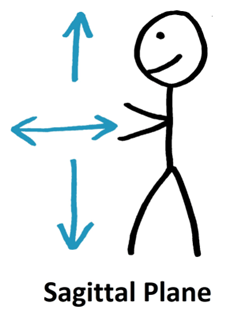
The sagittal plane relates to movements that involve going forwards and backwards; this can refer to your whole body or just to your limbs.
Therefore, moves on the sagittal plane include lunges and crunches but also front raises.
The way I like to think of this is to imagine that you’re trapped by walls on either side of you that limit your movement; you can’t step to your side or rotate your torso, and all you can do is move forwards or backwards.
So, the way to remember this is that the sagittal plane is like having walls to the side of you.
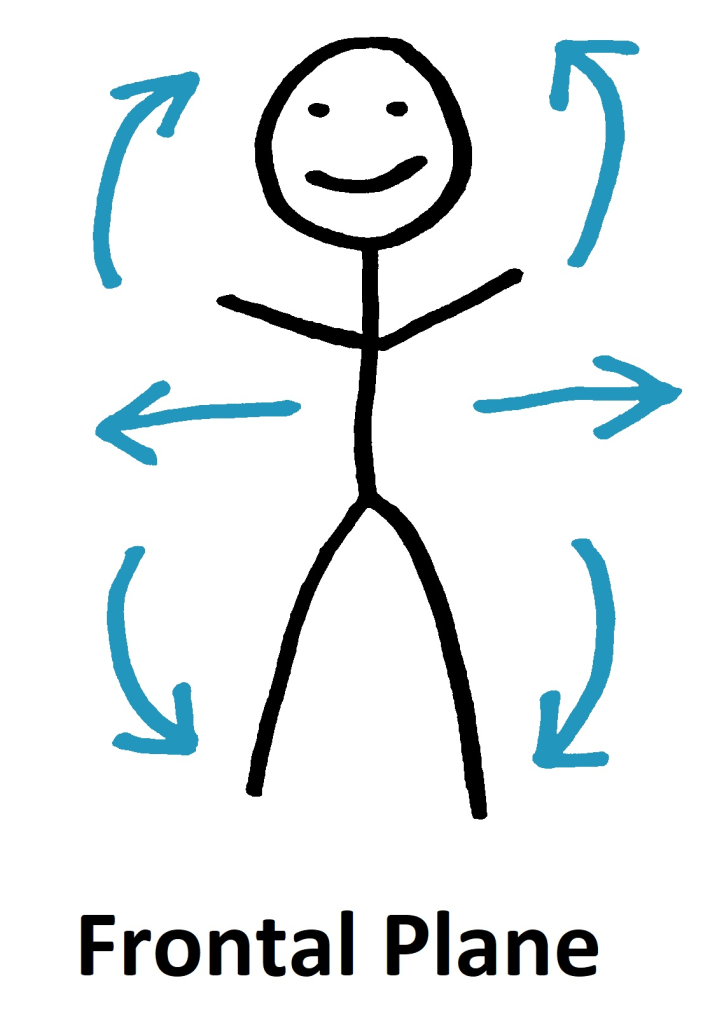
The frontal plane relates to sideways movements. Again, this can mean your whole body or just your limbs.
Therefore, side lunges and side bends are on the frontal plane but so are lateral raises and star jumps, where it’s your arms or legs that are moving at your sides.
I like to remember this by imagining there’s a wall in front of you; you can’t move forwards or backwards, or rotate your torso, but can move your body or your limbs to the side.
(It’s also worth remembering that the name can be confusing as it does not refer to movements in front of you, so a front raise does not take place on the frontal plane.)
So the way to remember this is that the frontal plane is like having a wall in front of you.
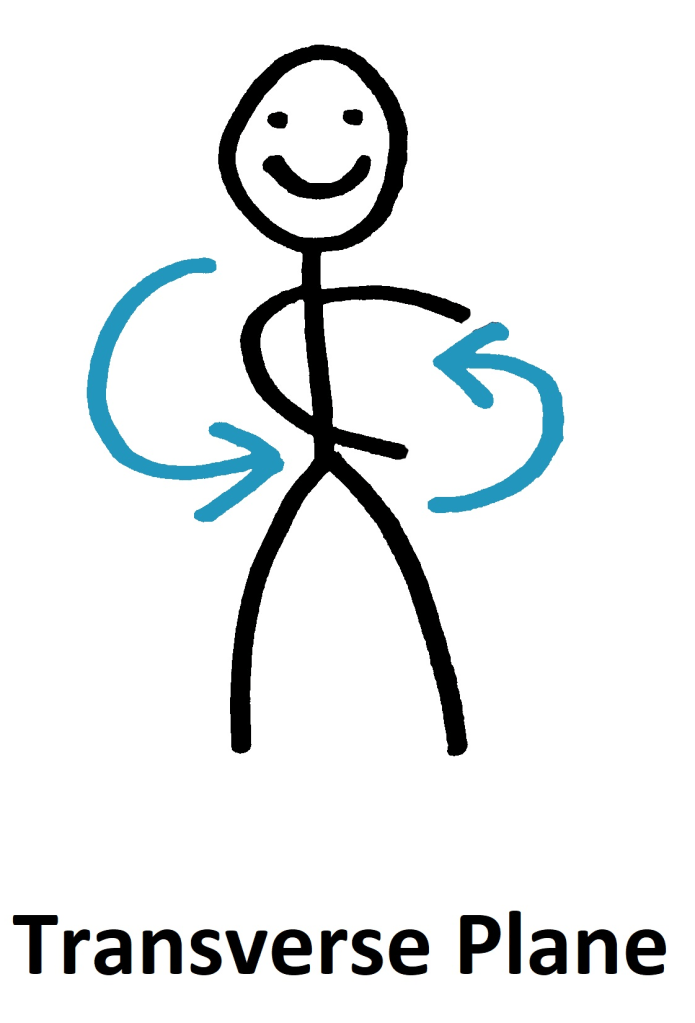
When I started learning about the planes of movement this was the one it took the longest for me to get my head around, but it’s not actually that difficult: you just need to imagine a line running vertically through the centre of the body and that any movements on the transverse plane involve rotating around that.
Therefore, movements on the transverse plane include rotational exercises such as woodchops, baseball swings and Russian twists.
However, here’s where it can get a bit confusing: exercises on the transverse plane also include ones where your elbows rotate around your body. So this includes push ups and bench presses; think about how your elbows are moving in relation to the centre line as you perform them.
You have to think carefully about this, though, as narrow grip push ups or close-grip bench presses do not take place on the transverse plane. This is because you tuck your elbows in to perform them, meaning the elbows are moving on the sagittal plane (forwards and backwards) rather than rotating around the body. I’ve seen exams with trick questions about this, where you have to think about the elbow movement to decide which plane a particular exercise is on, so it’s something to bear in mind.
Finally, it’s worth noting that moves on the transverse plane do not necessarily target the transverse abdominis muscle, despite the similar names. For example, a Russian twist is on the transverse plane but works the obliques rather than the transverse abdominis. It can be confusing as the etymology is the same, but you need to remember that the context is different: the transverse abdominis is a muscle that goes around the torso whilst the transverse plane refers to movements going around the torso
Why Knowing The Planes Of Movement Is Useful
Now you’ve (hopefully) learnt the differences between each plane of movement, how can they be useful to a trainer? Well, put simply, when working a particular part of the body it’s a good idea to include moves on all three planes so that the muscles are hit from different angles. To give an example of that, here’s how you could hit the core muscles using three planes of movement:
Sagittal plane: crunches (moving forwards and backwards and working the rectus abdominis)
Frontal plane: side bends (moving from side to side and working the obliques)
Transverse plane: Russian twists (rotating around the centre line and hitting the obliques in a different way)
Essentially, working on all planes of movement is a good way to ensure the body utilises its full range of motion, as well as making sure as many muscles as possible are hit from multiple angles.
And, finally, here’s a handy table that summarises them all:
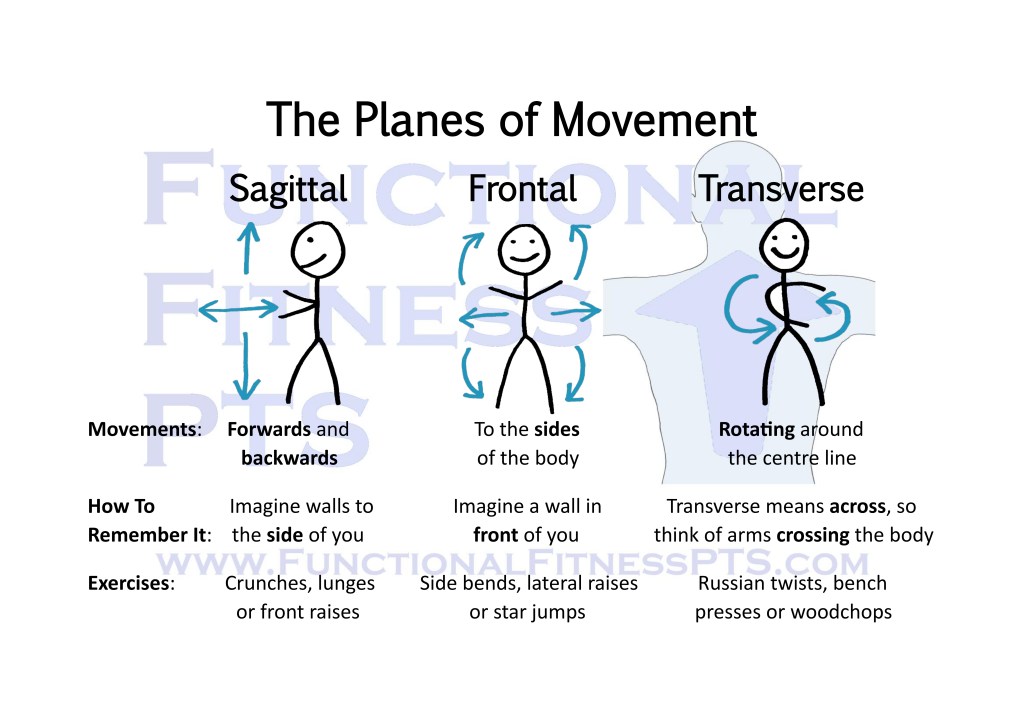
And you can download it here.
 Functional Fitness PTS