Here we’ve tried to address and answer some of the most common questions people have about nutrition. Including:
- What Is a Calorie?
- How Many Calories Do I Need?
- What Is Metabolism?
- Can I Change My Metabolism?
- Can I Burn Fat In Specific Areas of the Body?
- When the Body Burns Fat, Where Does It Go?
- What Does ‘Calculating Your Macros’ Mean?
- How Much Protein Do I Need?
- How Much Protein Should I Consume In One Sitting?
- Should I Consume Protein Within Two Hours of Working Out?
- Should I Take BCAAs?
- Should I Take Creatine?
- What Are the Different Types of Fat?
This article often takes a deep dive into these topics, so if you can’t be bothered to read all this, the key points are very succinctly summarised in this article.
And if there are any terms you’re unsure about, they may well be covered in the glossary.
What Is A Calorie?
A calorie is a unit of energy used by the body as fuel. Calories come from foods you consume including carbohydrate, fat and protein.
How Many Calories Do I Need to Consume?
This will depend on a number of factors, the first of which is your BMR or Basal Metabolic Rate.
This is the number of calories your body needs to fuel its basic processes (such as breathing, digestion and making the heart beat) before calories burnt through exercise are even taken into account.
You can find your BMR by using online calculators such as this one or by using a body composition scanner such as the Bodixtrax machine:
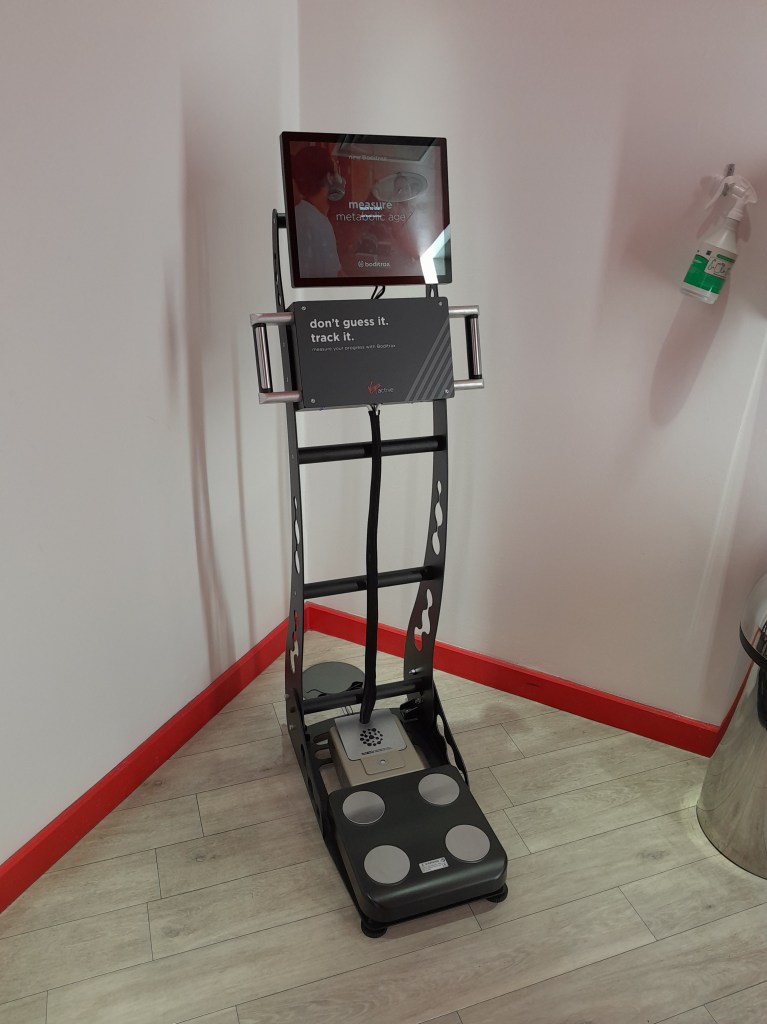
The next factor is your daily activity levels. BMR, remember, is only the calories your body needs to fuel functions such as breathing, digestion and the heart rate, so you then need to work out your total calorific requirements based on the amount of exercise you do then adjust them based on your goals.
- If You’re Aiming To Lose Weight
The basic idea is to consume fewer calories than your body needs. This means the body will use fat as fuel instead, and is known as a calorific deficit.
It’s generally seen as safe to have a calorific deficit of between 200-500 calories a day. You’d make an adjustment not based on your BMR but based on your total calorie consumption when activity and exercise levels are taken into account.
You can use online calculators such as this one to work out how much to reduce your calorie intake by: https://www.calculator.net/calorie-calculator.html
(We wouldn’t recommend following the ‘extreme weight loss’ option, however. It’s a bad idea to have a calorific intake that’s less than your BMR as then you’d be denying your body the fuel it needs to carry out basic functions.)
- If You’re Aiming to Build Muscle
As well as increasing your protein intake, you should consume around 200-500 extra calories a day. This is to ensure your body has the energy it needs in order to fuel the high intensity workouts you’ll be performing, rather than taking it from other sources.
There are online calculators you can use to tell you how many calories and how much protein you should consume based on your goals and activity levels, such as this one: https://www.macrocalculator.org/
What Is Metabolism?
Metabolism is the process of the body converting calories into energy in order to provide fuel. The speed at which this happens will vary from person to person.
Can I Change My Metabolism?
It has not been proven that you can change your metabolism on a cellular level, and a large study found that metabolism changes at various points during a person’s life-cycle but remains stable between the ages of 20 and 60.
However, it is believed that there are changes you can make in order to burn more calories. When people talk about ‘speeding up your metabolism‘ they are usually referring to ways you can do this, such as:
- Eating more protein, as the body uses more calories to digest protein than it does for other types of food.
- Putting on more muscle, as muscle is more metabolically active than fat, meaning that the more of it you have, the more calories you will burn.
- Performing high-intensity exercise, as this is believed to lead to EPOC, where the body continues to burn fat for several hours after you’ve finished exercising.
Can I Burn Fat In Specific Areas of the Body?
Known as ‘Spot Reduction’ or ‘Spot Fat Reduction‘, there’s a commonly-held but unproven belief that you can burn fat in specific areas of the body by performing exercises that target them, such as burning belly fat by performing crunches.
This has long been a topic of debate, with some studies suggesting it may be possible, but others stating fat distribution is caused by factors beyond your control.
It’s generally believed that spot fat reduction doesn’t work and that if, for example, you wish to see more definition in your abs then you’ll need to perform ab exercises in order to grow the muscles there as well as performing cardio exercise and eating less in order to lose overall body fat and therefore let those abs become more visible.
Despite this, it’s sadly not unusual for fitness journalists to write articles with titles like ‘Here Are The Best Ways To Burn Belly Fat!’ that immediately admit ‘there are no exercises that are best to burn belly fat’ and instead provide you with methods you can use to burn body fat in general, such as by performing HIIT, being in a calorie deficit and eating more protein.
There is some good news, though; whilst it’s not been proven that you can reduce belly fat with specific exercises, some research has indicated that you can reduce the amount of visceral fat you gain by consuming unsaturated fats (such as fish, seeds and nuts) rather than saturated fats (such as fried foods and animal products).
But, just to be clear, whilst visceral fat is found at the abdomen, it’s not the only form of belly fat because subcutaneous fat can form there too; therefore, even if you reduce visceral fat that doesn’t necessarily mean all your belly fat will be gone.
When the Body Burns Fat, Where Does It Actually Go?
An entirely fair question. First of all, fat doesn’t turn to muscle, and neither does muscle turn to fat.
If you don’t know where fat does go, that’s understandable, as a report by the BMJ found that 98 percent of the doctors, dieticians and personal trainers they surveyed didn’t know either.
The simple, and possibly surprising, answer is that fat mainly leaves the body when you breathe out, with the rest going when you urinate.
The simplest scientific explanation we can offer is that when the body creates energy by burning fat it does so in conjunction with oxygen. Fat is mainly carbon (C) and hydrogen (H) whilst oxygen is O2, so when these things are combined you get CO2 (carbon dioxide) and H20 (water); the first is breathed out and the second is urinated out.
The more complicated chemical explanation (which we’re definitely not intelligent enough to understand) can be found in the BMJ report here.
What Does ‘Calculating Your Macros’ Mean?
Macronutrients are things we eat in larger quantities, including fat, protein and carbs. (As opposed to micronutrients, which include vitamins and minerals, consumed in smaller amounts.)
When people talk about ‘calculating their macros’, this means they are finding out how much of each one they need in order to help with their training goals.
Put simply, ‘calculating your macros’ means working out how much protein you need to build muscle and how many carbs you need to fuel your workouts. You can work out your macros using online calculators like this one: https://www.calculator.net/macro-calculator.html
How Much Protein Do I Need?
Protein has many roles within the body (and you can read a deep dive into its structure and functions here) but from a gym perspective its most useful role is that it helps with tissue regrowth, so is what you need to repair and build muscle.
How much of it you need to eat depends on various factors including your weight as well as how hard and how often you work out.
There is also considerable debate regarding how much protein you should consume but a summary of current thinking is:
- For sedentary people: 0.8g of protein per kg of bodyweight per day (though many sources argue this is not enough)
- For active people: somewhere between 1.2g – 1.8g of protein per kg of bodyweight per day (though sources vary considerably regarding this)
- For elite athletes and people looking to develop strength or build muscle mass: 2g of protein per kg of bodyweight per day (though a study by the British Journal of Sports Medicine found no increase in strength gains or muscle mass from consuming more than 1.6g per kg of bodyweight).
However, the good news is that there are online calculators you can use to help you work this out, like this one: https://www.macrocalculator.org/
Again, due to the debate over how much protein you should consume, you will get different results on different sites, but the above one appears to be one of the better ones; along with getting you to enter details such as weight and height, it also takes into account your activity levels.
How Much Protein Should I Consume In One Sitting?
Again, this is an area of some dispute, and is addressed here.
Some sources say you should consume 25-30g of protein at a time, whereas a study by the Journal of the International Society of Sport Nutrition concluded that you should consume 0.4g of protein per kg of bodyweight per meal over a minimum of four meals a day.
For someone weighing 65kg, this would work out at 26g per meal, suggesting the recommendation of 25-30g isn’t too far off the mark.
Should I Consume Protein Within Two Hours of a Workout?
Whilst it was once believed that you should consume protein as soon after your workout as possible in order to maximise recovery and muscle repair (a period referred to as the ‘anabolic window‘) that idea has fallen out of favour, and a study by the Journal of the International Society of Sports Nutrition concluded that the evidence for an ‘anabolic window was ‘far from definitive‘, though said it might be useful if nothing at all had been consumed for several hours prior to the exercise session.
Overall, however, the current thinking seems to be that regular and even protein consumption during the day is more beneficial than ensuring you have some immediately after your workout.
Should I Take BCAAs?
Protein is made up of amino acids, and three of these are known as BCAAs, or Branched-Chain Amino Acids.
Whilst protein powders already contain the three BCAAs, you can also take supplements that contain them in greater amounts.
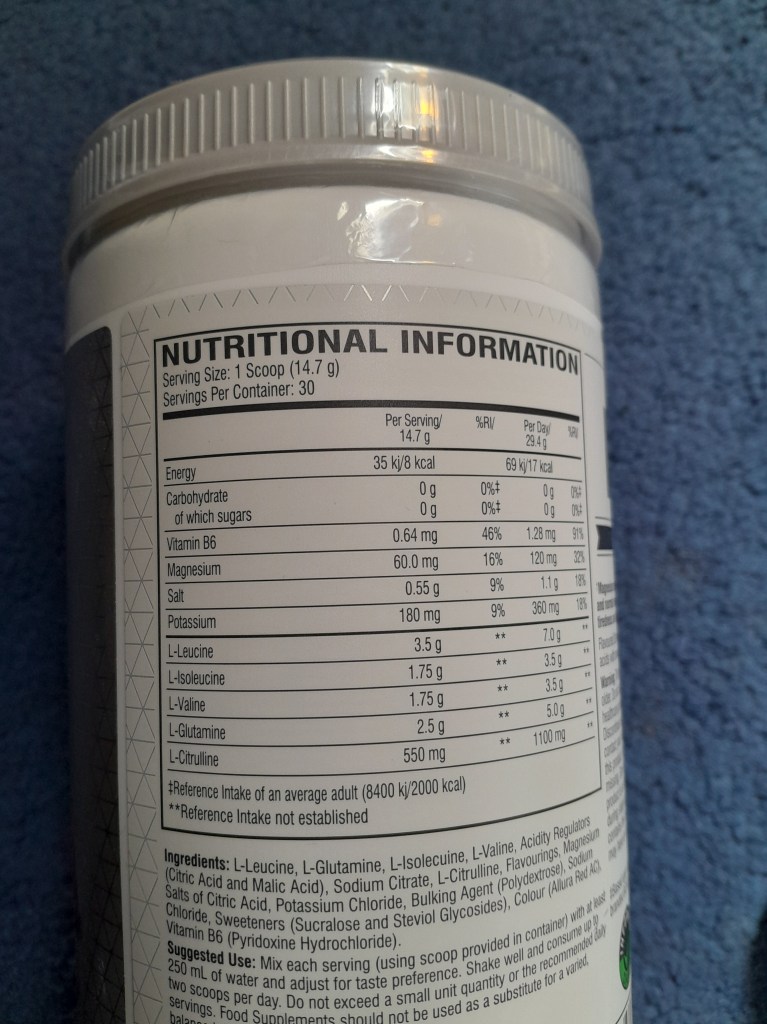
The three BCAAs all have functions within the body that make them beneficial when performing exercise, with some research indicating that taking them can help improve muscle growth, reduce muscle soreness and assist with endurance.
Other studies, however, have been more pragmatic, arguing that whilst there is some evidence of the benefits of BCAA supplementation, it is currently inconclusive and more research is needed.
Some people report that taking BCAAs before and during a session gives them more energy, whilst others do not notice any difference.
With regards to how much you should consume, the recommended total daily dose is up to 20g, though this should take into account the BCAAs you obtain from your diet.
Of the BCAA supplements available to take before and during a workout, the exact proportions vary but a scoop is usually between 6-15g and will generally contain around 2.5-3.5g of leucine, 1.5g of isoleucine and 1.5g of valine.
Should I Take Creatine?
Creatine is involved in the production of energy within the body, and is often taken as a supplement in order to provide a boost of energy.

Some people mistakenly believe that creatine will give you bigger muscles in the same way steroids do, but this isn’t quite true; creatine will help you work harder, so can indirectly lead to muscle growth.
In addition, it is believed that creatine contributes towards ‘the pump‘, the short-term increase in muscle size you get after a workout as the result of additional blood being transported to the muscles you’ve worked. The thinking behind this is that taking creatine leads to additional water retention in the muscles, which makes them look bigger. However, this is temporary, and not the same as your muscles growing due to the muscle fibres becoming thicker. (It may also be worth noting that this water retention can mean that overall weight gain is a side-effect of creatine supplementation.)
Therefore, some people find creatine useful in order to help fuel their workouts as well as giving them a short-term increase in muscle size.
Furthermore, there’s a growing body of research indicating that creatine supplementation is beneficial in a variety of ways, including improving brain function, relieving tiredness, helping with depression and even possibly alleviating the symptoms of Alzheimer’s. (Much of this research relates to the role creatine plays in forming new neurons in the brain.)
Regarding how much creatine you should take, the most effective dose does not appear to have been agreed upon, but the most common method of consuming it is to undertake a maintenance phase, where 5g is taken per day, usually before a workout.
In some cases this is preceded by a loading phase, where 20g is taken a day, split into four servings of 5g, for five days, after which the maintenance phase is followed.
What Are The Different Types of Fat?
Saturated Fats, also known as ‘bad fats‘ are generally derived from animal sources such as meat and diary, and are considered unhealthy.
Unsaturated Fats, also known as ‘good fats‘, can be polyunsaturated or monounsaturated, and are generally derived from plant sources. They are found in things like avocados, nuts, seeds and olive oil, as well as oily fish, and are considered healthier.
(Fun fact: despite being promoted for its supposed health-giving benefits, and being from a plant source, coconut milk is surprisingly high in saturated fat.)
 Functional Fitness PTS