
Onset of Blood Lactate Accumulation (OBLA) may seem like one of those arcane scientific terms that’s of little practical value to a personal trainer, but once you understand what it is it’ll soon become apparent that it’s not only useful in explaining why your muscles start to cramp during high-intensity exercise but also that it can be put to use when designing workouts for clients.
So, let’s first of all look at what it is:
When exercise is performed beyond a certain intensity this causes lactate to build up more quickly than the body can dispose of it.
This is what causes your muscles to cramp and prevents you from performing any more reps until you have had a rest.
This build up of lactate is referred to the Onset of Blood Lactate Accumulation, or OBLA.
The point beyond which lactate builds up more quickly than the body can flush it out is known as the lactate threshold (also known as the anaerobic threshold).
Once your lactate levels have gone above the lactate threshold you will soon have to stop the exercise and wait until your blood has flushed out enough lactate to make the levels more manageable again.
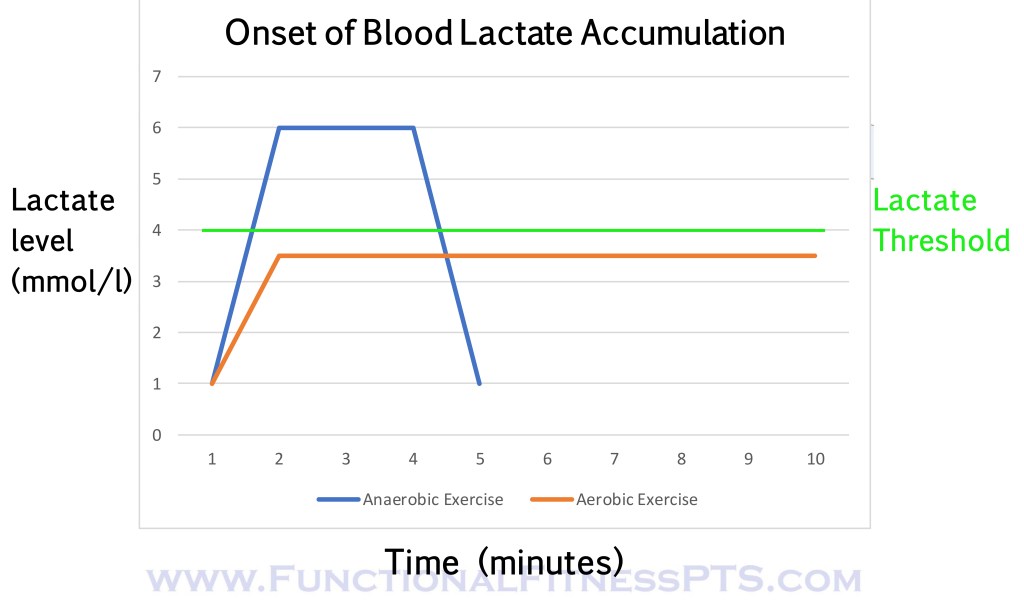
The level of lactate in the blood above which the body struggles to flush it out quickly enough (the lactate threshold) is commonly believed to be 4 mmol/l (4 millimoles of lactate per litre of blood).
In practice, this is why you can run for longer at a lower intensity than you can at a higher one. The orange line in this diagram illustrates how you can sustain aerobic activity for longer because you are staying under the lactate threshold (the green line) compared to how if you carry out anaerobic activity, such as running at a faster pace, you will only be able to sustain it for a few minutes before you start to tire out (the blue line):
Training Systems Utilising OBLA
Training can be carried out in such a way that it makes use of the lactate threshold.
If you run on a treadmill at a pace that you can sustain for more than a few minutes then you are utilising the aerobic energy system and staying below the lactate threshold.
If you run on a treadmill and alternate between a higher intensity that you can only sustain for a few minutes followed by a recovery period at a lower intensity then you are alternatively going above and below the lactate threshold and switching between the aerobic energy system (for the higher intensity stage) and the aerobic energy system (for the lower intensity stage).
(And if you need a refresher on the energy systems then you can read the article about them here.)
The following diagram looks at this in practice, and how the intensity level relates to the lactate threshold.
The blue line represents interval training, where you cross the lactate threshold for a certain amount of time (usually a few minutes) then lower the intensity until the lactate levels have reduced and you can increase the intensity again. Therefore, you are alternating between being above and below the lactate threshold.
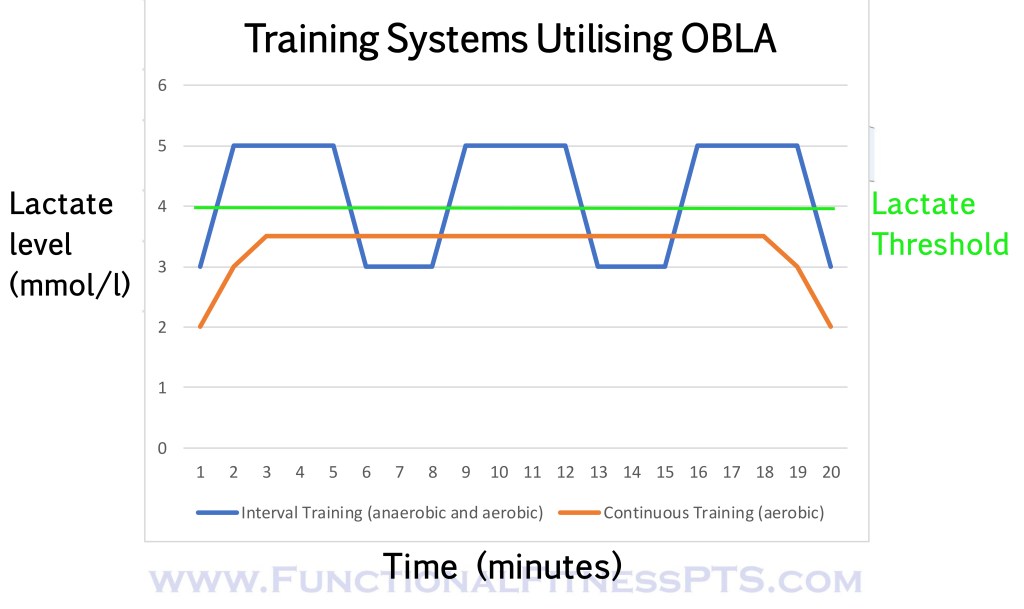
The orange line represents continuous training, where you stay below the lactate threshold and sustain that intensity for as long as is required. Because you do not cross the lactate threshold, the lactate build up never reaches a point where you cannot continue (so if you do have to stop this is instead due to your cardiovascular fitness).
Important: OBLA is not the same as DOMS!
DOMS stands for Delayed Onset Muscle Soreness and refers to the soreness and stiffness you feel in your muscles after a workout, usually the next day or in the next two to three days (a figure of 12-72 hours is sometimes given). DOMS is believed to be caused by the microtears in the muscle fibre that result from weight training.
OBLA refers to the aching or cramping in your muscles you feel during a workout, whilst you are performing a move.
Level 3 exams sometimes ask you the difference between the two, and whilst they are both types of muscle soreness, the way to remember this is to think about when they happen:
DOMS happens after the workout
OBLA occurs during the workout
 Functional Fitness PTS