Okay, so you’re about to head off to the gym? Well done! Still, once you’re there, what are you going to do? True, if you’ve had an induction then the PT who conducted it should have given you some idea, but if you don’t want to keep on paying them then you’ll have to decide for yourself at some point. So, here are some pointers to bear in mind that should hopefully help you stay motivated, focused and safe:
- Decide upon your aims for the session
- Choose specific exercises to help you achieve your aims
- Plan your session in detail beforehand
- Make sure you measure your progress
- Don’t be too ambitious too soon
- Ensure your workouts don’t neglect any muscle groups
Throughout this article we’re going to make reference to different parts of the following session plan. Any good PT should use something like this (either on paper or on a tablet/phone) to show they’ve got a proper plan for your session and have taken notes of your aims as well as any issues you have (whereas a bad PT will just wing it or use the same plan for everyone). If you’re training on your own then it’s a good idea to use something similar (though it doesn’t need to be as detailed):
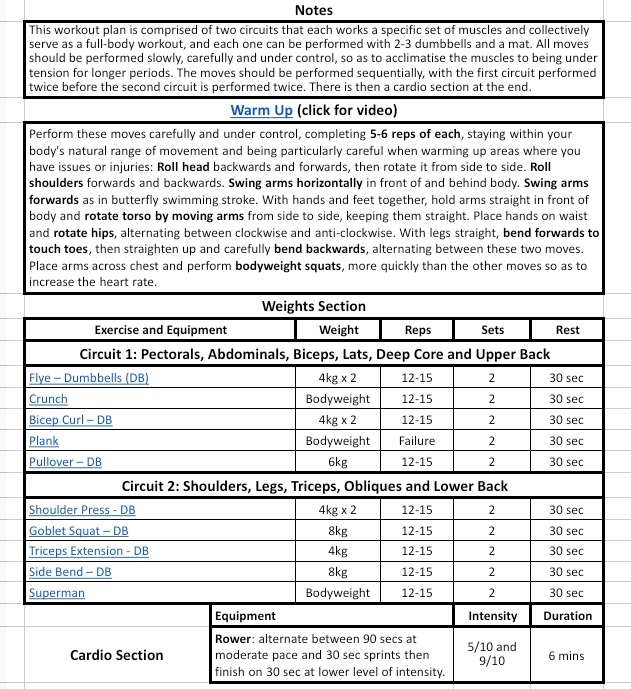
(This session plan is suitable for absolute beginners; you can read more about it here, and the moves are explained here.)
Decide Upon Your Aims for the Session
Exactly why did you join a gym in the first place? That may seem like a stupid question until you start to break it down, because if you ask a lot of people why they joined a gym they’ll vaguely reply, ‘oh, you know, I want to get a bit fitter, lose a bit of weight, put on a bit of muscle…’
But if you don’t have a clear idea of what you want to achieve, how will you know if you’re achieving it? Therefore, it’s a good idea to stick to one main goal when you start going to the gym and doing exercises to help with that. These could include:
- Improving general fitness, in which case you’ll want to focus more on cardio.
- Increasing strength and muscle mass, in which case you’ll want to focus on weight training.
- Losing weight, in which case you’ll want to do both weight training and cardio, as well as paying careful attention to your diet.
Once you know what your overall aim is you can plan your session accordingly, by choosing to do cardio or weight training as well as deciding how long you’ll do particular exercises for, and at what intensity. (And you don’t have to stick with one goal forever; if you get stronger but feel your cardio is lacking then you can focus more on that, or once you’ve lost weight you can focus more on putting on muscle, for example.)
If you’re new to the gym then a good goal to focus on is to improve your muscular endurance. This is where you get your muscles used to being under tension for longer periods, and as well as improving your functional strength is a good way of laying a foundation of strength upon which you can then build once you’ve decided upon a more specific goal.
Using this session plan is a good way to work towards that. In it, muscular endurance is improved by performing the moves slowly and under control, for 12-15 reps, and increasing the weights once you can perform 15 reps of an exercise, meaning you improve gradually and safely.
The shorter rest periods, combined with the cardio section at the end, means it will also contribute to overall fitness. In fact, if you follow this plan whilst also reducing your calorie intake you should also see some weight loss.
Choose Specific Exercises to Help You Achieve Your Aims
Sometimes you see guys at the gym whose internal monologue seems to run pretty much like this:
‘Hmm, what’s free? The treadmill? Okay, I’ll do that for a bit. How long? Not sure. Then, ooh, arms? Could do. Yeah, why not. Bicep curls? Okay. What weight? Probably doesn’t matter. How many reps? Oh, a few, I reckon. Ooh, the rower’s free now so I’ll randomly go back to cardio! Right, what’s next? Legs? Yeah, okay. All right, I’m at the end of my session! What have I achieved?’
Well, very little, because you didn’t even know what you wanted to achieve. There was no focus. If you want to get stronger then the treadmill won’t help, whilst your cardio won’t be greatly improved if you focus on lifting weights. People without a clear idea of what they want to do won’t see any real improvements, which is why a lot of people give up.
However, if you’ve chosen your overall aims they will be able to help you plan each session. If your aim is improving your cardio then you’ll want to focus on running, rowing, cycling and any other exercises that get your heart rate up. If you want to get stronger and put on muscle then you’ll want to focus on lifting weights.
The aim for this session plan is to increase full-body muscular endurance (helping you start to get stronger), and you can see the moves have been carefully chosen so that all the major muscles are worked:
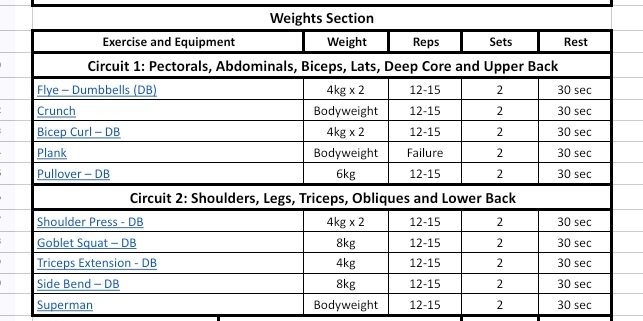
Further down the line you’ll probably want to work different muscles in different sessions, but a full-body workout is a great place for beginners to start out.
Plan Your Session in Detail Beforehand
Following on from the previous point, if you know exactly what you’re going to do before you even get to the gym then it’ll make things much easier and give the session a focus rather than just have you winging it. Once you’ve decided if your session is aimed at cardio or strength you need to think about the specifics. What equipment are you going to use? How long will you use it for? Which moves are you going to do?
You’ll also need to think about the overall structure of your workout. Fortunately, this is one of the easier parts as there is a generally accepted way to conduct a workout:
- Start off with a warm up
- Then do your resistance exercises (weight training)
- Follow that with cardio work (running machine, exercise bike etc)
- Finish with a cool-down
Obviously if you’re just focusing on cardio then you may skip the resistance section and if you’re focusing on strength then you’ll probably not do the cardio section, but the main takeaway from the above is to make sure you factor in a warm-up and cool-down, including stretching!
Sure, if you’re in your twenties you can probably get away with not properly warming up, but even then it’s not recommended. If you’re any older than 35 then you should definitely warm up, and here’s a helpful guide to just what you should do both before and after a workout to ensure your body’s properly prepared for the session and adequately brought back to reality afterwards.
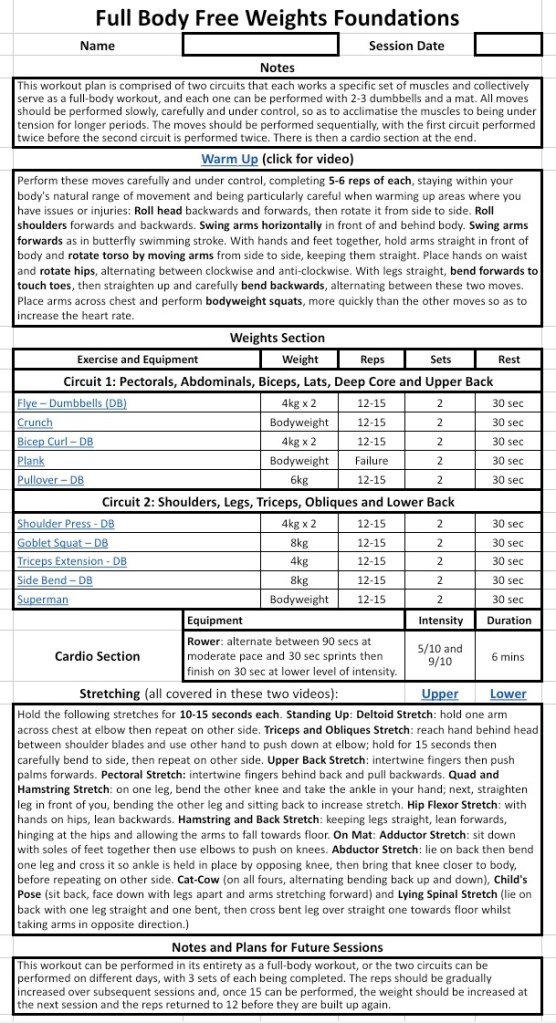
Here you can see how this session plan has covered everything from the warm up to the stretching, as well as the exact weights, reps, sets and rest periods:
Make Sure You Measure Your Progress
I once had a discussion/debate/heated argument with a personal trainer who proudly boasted that he never recorded the reps or sets that his clients did, and that everything was judged and measured ‘based on how they felt’, which I suppose is okay for some people, but if you don’t record what you do in the gym then how will you know if you’re improving?
So that’s why I recommend recording what you’ve done in each session, in terms of the reps you did and the weights you lifted. This not only means you can measure your progress over time but also helps to maintain your motivation. There are apps out there to help you do this, or you can simply use a good old-fashioned notebook (which has the added advantage of meaning that if you drop a weight on your workout plan then the worst thing that happens is that your pen gets broken, rather than you having to visit your local phone repair shop…).
Don’t Be Too Ambitious Too Soon
Remember you’re a beginner and don’t try to compare yourself to or compete with the biggest and strongest guys in the gym. Things to consider in relation to this include:
- Don’t Aim for PBs or 1RMs
If you don’t know what these things stand for that’s probably good for now. All you need to know is that they’re ways of trying to lift the heaviest weight you possibly can, which for a beginner is not a good idea at all. At this stage you shouldn’t be trying to lift the heaviest weight you can because you’ll injure yourself.
- Start with Light Weights
Find a weight you think you could lift for ten reps. And once you’ve done that, return it to the rack and choose the next one down. Trust me, a weight that feels okay when you do two or three speculative bicep curls will feel much different when you’ve struggled to do ten reps slowly and you feel like your arm’s about to drop off.
- Even Better, Start with Machines
Machines limit your range of movement, meaning they kind of force you into performing the move correctly. Therefore, they’re a safer way of doing an exercise than free weights so are useful for beginners. You can always ask someone to show you how to use them, but the good news is that it’s quite hard to go wrong. You can’t drop anything on your foot (or worse, your face) and they usually have handbrakes to stop them if you think you’re in trouble.
- But Don’t Be Afraid of Lifting Weights
Lifting weights doesn’t have to mean breaking your back on the squat back. (In fact, it’s probably a good idea if you don’t do that). There are plenty of other ways you can challenge your muscles by putting them under tension, including using resistance machines, resistance bands or, well, just using lighter weights, but it’s a very good idea to do some sort of resistance training regardless of your age, gender or training goals.
Women are sometimes wary of lifting weights in case it makes them bulky, but in practice it takes a fair amount of work to pack on significant muscle, so it’s certainly not something that’s going to happen unintentionally. And as muscle mass declines as you get older it’s a good idea to perform some form of resistance exercise to mitigate that, as it not only helps maintain muscle but helps keep your bones strong.
Ensure Your Workouts Don’t Neglect Any Muscle Groups
One of the key tenets of functional fitness is to ensure your workouts are comprehensive and cover all areas of fitness. So, along with doing cardio and resistance work you should make sure your balance, mobility, flexibility and agility are worked on.
However, you should also make sure you’re not neglecting anything within each of these areas, and in the case of weight training this means you shouldn’t be working some muscles whilst not working others.
Muscles each have an opposing muscle, meaning that there’s one that pulls in one direction and another that pulls in the other. For example, the bicep bends your elbow by pulling your forearm towards to your upper arm, whereas the triceps extend your elbow, straightening your arm by pulling on the other side of it.
What this means is that if one muscle is stronger than its opposing muscle then you’ll end up with an imbalance. Therefore, we strongly recommend that you ensure all your major muscles are being worked. Work your biceps but also your triceps. Work your chest but also your upper back. Work your abs but also your lower back. These things are all connected, and if one muscle becomes significantly stronger then it won’t be able to play its intended supporting role when you’re working the other muscle, and you risk getting injured.
There are just a couple of things we’d add here, though. Yes, it’s true that muscle men do ‘leg day’, ‘chest day’ or whatever, focusing on just one muscle group, but they should still be working all the muscles at some point; they’re just doing them on different days. You can by all means do something similar as you get better, but you risk mobility problems if you become obsessed with working one particular muscle group at the expense of its opposing muscles.
And that’s the other thing: you sometimes see muscle men who’ve worked their chest in order to make it massive but haven’t worked their back muscles as much because they’re not as visible. What often results from this is a postural issue where they become hunched and walk around with their shoulders drawn forwards, simply because the chest muscles are pulling them that way but the back muscles aren’t strong enough to balance this out by pulling them back.
So let’s have one final look at the lesson plan to see this in action. This workout trains the chest (flyes), abs (crunch), biceps (bicep curl), lats and deep core (pullover), upper back (bent over row), shoulders, legs (goblet squat), triceps (triceps extension), obliques (Russian twist) and the lower back (Superman). Nothing is left out!
Finally, it’s worth stating that you shouldn’t work something that’s injured in case you make it worse. If it’s something that’s not too serious, such as a twinge, then you can just work another part of the body until it’s got better. However, a lot of physio and mobility work these days does actually involve exercising injured areas in order to make them stronger rather than just neglecting them forever. Sure, if you have an injury then make sure you speak to your doctor or physio to find out whether it’s safe to work whatever’s affected, but in the longer term you want to reach a point where you can work it without any problems, and part of the journey to get there means working it rather than ignoring it and letting it get even weaker.
So there you are! The key takeaway from this should be that before you even go to the gym you should not only know what you want to achieve but also know how you’re going to achieve it!
 Functional Fitness PTS