
Sadly, the Level 3 syllabus requires you to learn a frankly staggering amount of anatomical knowledge. It’s unlikely we’ll ever cover it all here (hey, that’s what your tutor and course manuals are for) but what we will try to do is help you remember particular facts.
One thing we’ve seen crop up in the exam is the anterior longitudinal ligament and the posterior longitudinal ligament.
From Level 2 you should remember that anterior means front and posterior means back, and that a ligament attaches bone to bone.
Furthermore, longitudinal means to run from the bottom to the top.
In addition, these two ligaments are both found on the spine.
So, when we add all this together we can see that the anterior longitudinal ligament and the posterior longitudinal ligament attach bone to bone (in this case the vertebrae), that they run vertically up the spine and that one is on the front and the other is on the back.
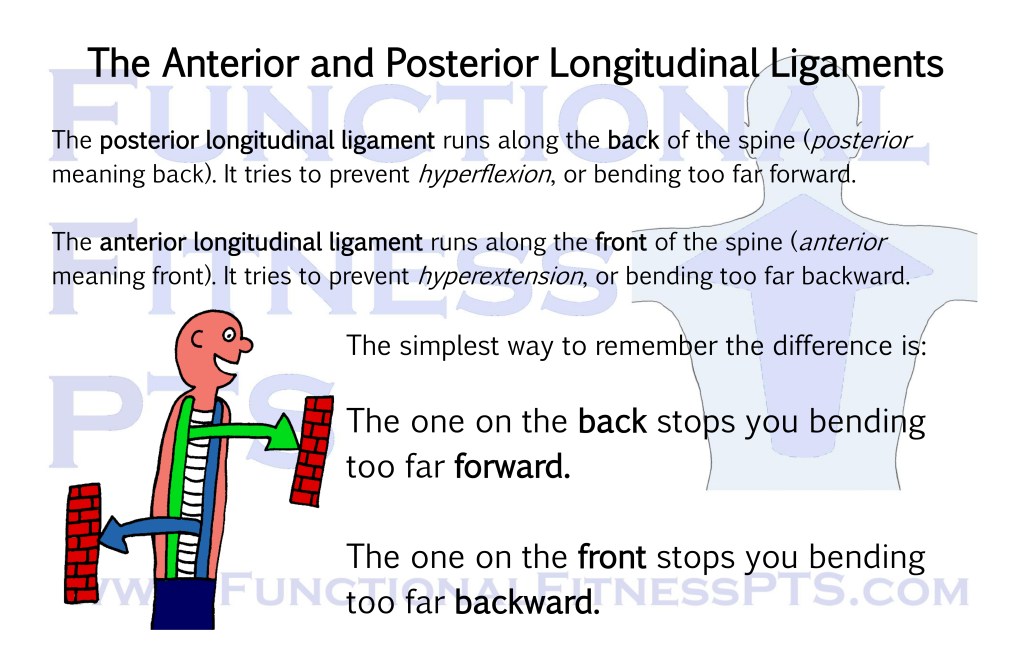
And why does the syllabus want you to know this? Well, it appears in the section on posture, and what you need to remember is that each of these ligaments has a role in preventing excessive bending of the spine. One tries to stop you bending too far forwards and the other tries to stop you bending too far backwards.
The exam may ask you which is which, and that’s why we’ve come up with this way of remembering. All you need to keep in mind is that each one limits movement in the opposite direction to where it’s located.
So, the one on the front stops you bending too far backwards whilst the one on the back stops you bending too far forwards.
And here’s a diagram to illustrate this. Needless to say, it’s somewhat oversimplified, but it should help you visualise and, crucially, remember the difference between the two:
You can download this diagram here.
 Functional Fitness PTS