It’s probably fair to say that a lot of people might struggle if you asked them to go into detail about what the differences between a squat and a deadlift are. Sure, they share some similarities, chiefly that both involve moving up and down whilst holding a weight, as well as working many (but not all) of the same muscles, but there are still a number of significant differences between the two that you should know if you perform them and should definitely know if you’re trying to teach them.
This may seem obvious, but the first thing to consider when thinking about the differences between a squat and a deadlift is their names: to squat means to lower your body by bending your knees, whereas a deadlift tells you that you’re lifting something.
The smaller differences are often quite subtle, though, so here we’re going to break down the key points individually and look at them in detail so you can perform the squat and deadlift effectively and, crucially, safely.
So, these key points are:
Starting Position of Weight
This is a fairly obvious one: broadly, a squat begins with the weight on the shoulders whereas a deadlift begins with the weight on the floor.
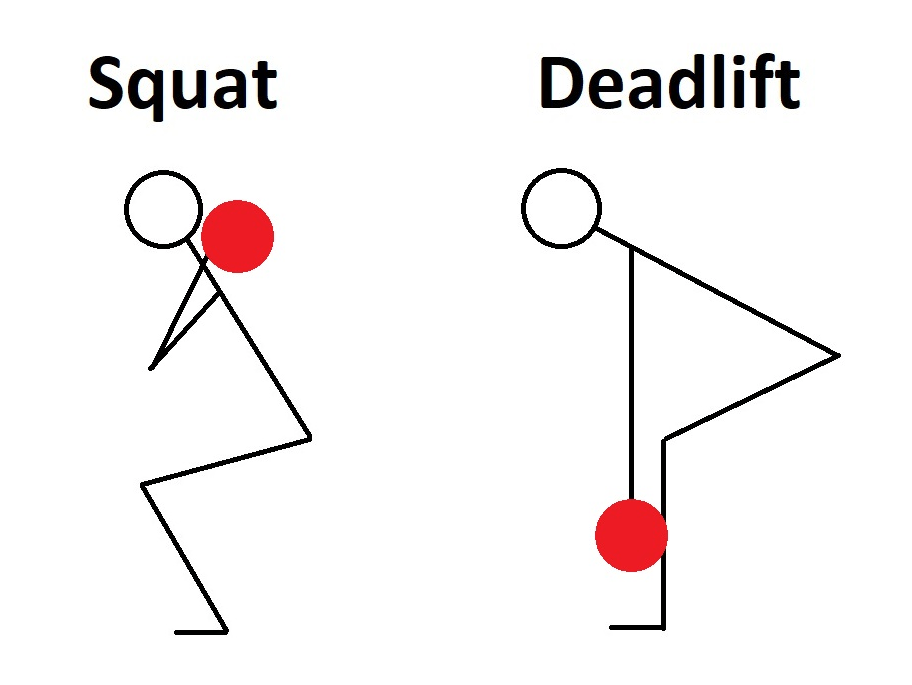
This means that you can lift more weight with a deadlift, as you don’t have to hoist it onto your shoulders first, making it better for working on pure strength, whereas a squat is more suited to performing a higher number of reps.
(Of course, there are exceptions to this rule: whereas the stiff-legged deadlift sees the weight lowered all the way to the floor, the Romanian deadlift has the weight stop at the shins; therefore you could argue it fails to precisely meet the criteria to be called a deadlift due to the weight not ending up in a ‘dead’ position on the floor, but also offer the counterargument that the fact it stops moving means it does meet them. You can also perform a squat with a dumbbell in each hand and the arms hanging straight down, which purists could argue isn’t a ‘proper’ squat either; I’ve also seen PTs have clients do this yet call it a deadlift, which rather proves the point that it can be difficult to clearly differentiate between the two.)
Main Joint Hinges
This is where it starts to get more confusing. It’s true that when performing either move you’re going to bend both the knees and hips but the amount you do this will actually depend on which move you’re performing, with the differences being:
Deadlift: the hips should be bending more than the knees (which should move minimally so as to keep the shins straight).
This is because you’re essentially bending over in order to pick up the weight, meaning your hips have to hinge more so that your torso can lean forward and down. This also means that your glutes will be pushed further back in a deadlift than they would during a squat, so you should feel it there more when carrying out this move. If you’re performing the deadlift using a barbell, having your knees too far forward also means they’ll be in the way as you lift the weight upwards.
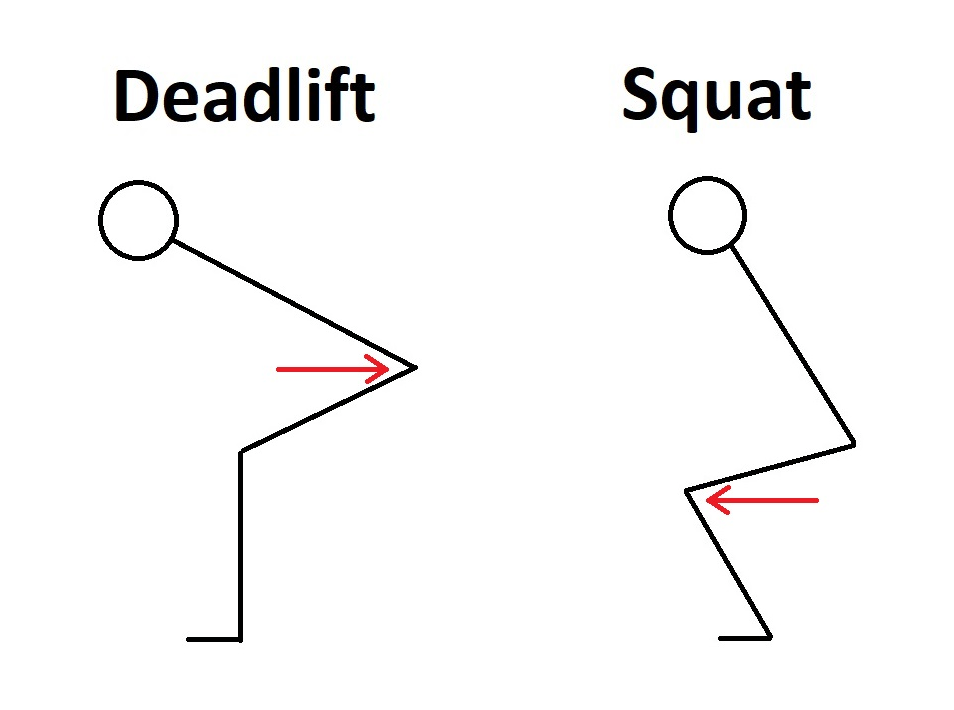
Squat: the knees and hips bend to a similar angle. The knees bend more than in a deadlift, as well as moving forward, and the hips hinge less than in the deadlift.
In a squat your torso stays more upright than in a deadlift, so there is less hinging at the hips, though the angle of both the hips and the knees are much closer in this move than in the deadlift.
And if you want a good way to practice hip hinges in preparation for doing a deadlift, this is our handy guide:
Shin Position
Squat: if the knees are bending correctly then the shins should tilt forward.
In fact, a good way to check if someone is performing the squat correctly is to see if the torso is at the same angle as the shins, which it should be if the knee position is correct.
(However, a lot of people struggle to do this as a result of having weak tibialis anterior (shin) muscles, something that PTs will often discover with new or even experienced clients; the reason for this is often that people work the calf muscles using moves such as calf raises but neglect the muscles on the front of the legs, which creates a muscular imbalance affecting their ability to squat properly, but the good news is that it can be worked on.)
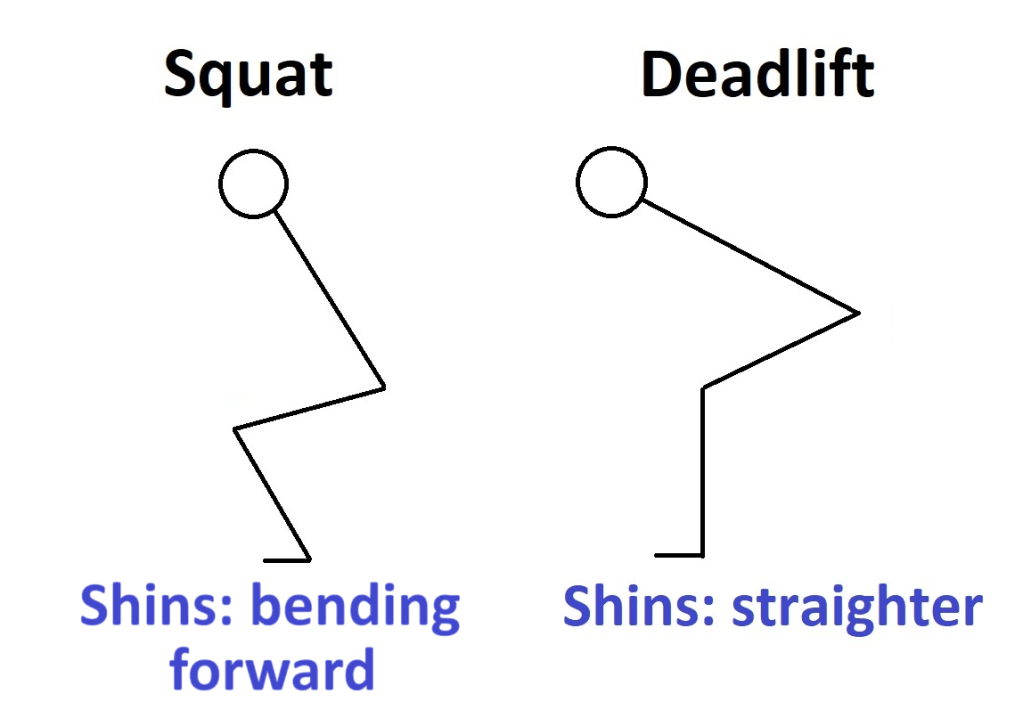
Deadlift: because the main hinge happens at the hips, the shins should be more or less straight. As mentioned above, if the shins are too far forward during a deadlift it will make it harder for the barbell to pass them as it’s lifted.
In fact, a very simple way to differentiate between a squat and a deadlift is to look at the angle of the ankle: in a squat the ankle should bend so the knees can move forward whilst in a deadlift the 90-degree angle of the ankle should be maintained.
Torso Position
Squat: as mentioned earlier, the torso should be at the same angle as the shins, which is to say it should lean forward slightly, but not too far; remember, you’ve got a weight on your shoulders so if you lean too far forward you risk losing your balance.
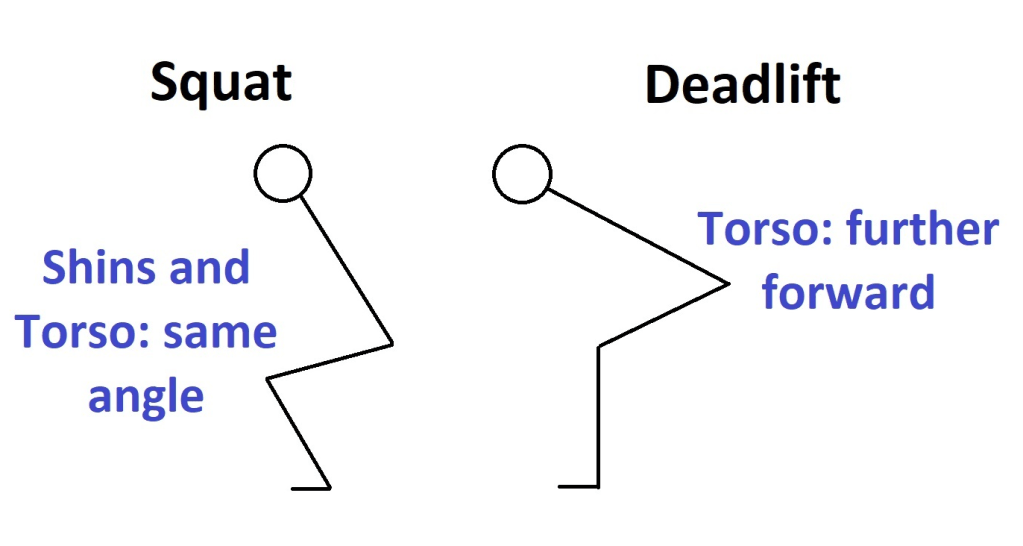
Deadlift: as the deadlift involves bending over to pick up a weight it goes without saying that the torso should lean forward more than in a squat. You usually won’t end up with your torso being parallel to the floor, but it should be significantly further forward than during a squat.
So there we have it. These moves are superficially similar but, as we’ve seen, once you examine them in more detail there are a number of subtle but important differences. Finally, here’s a table that summarises what’s been covered:
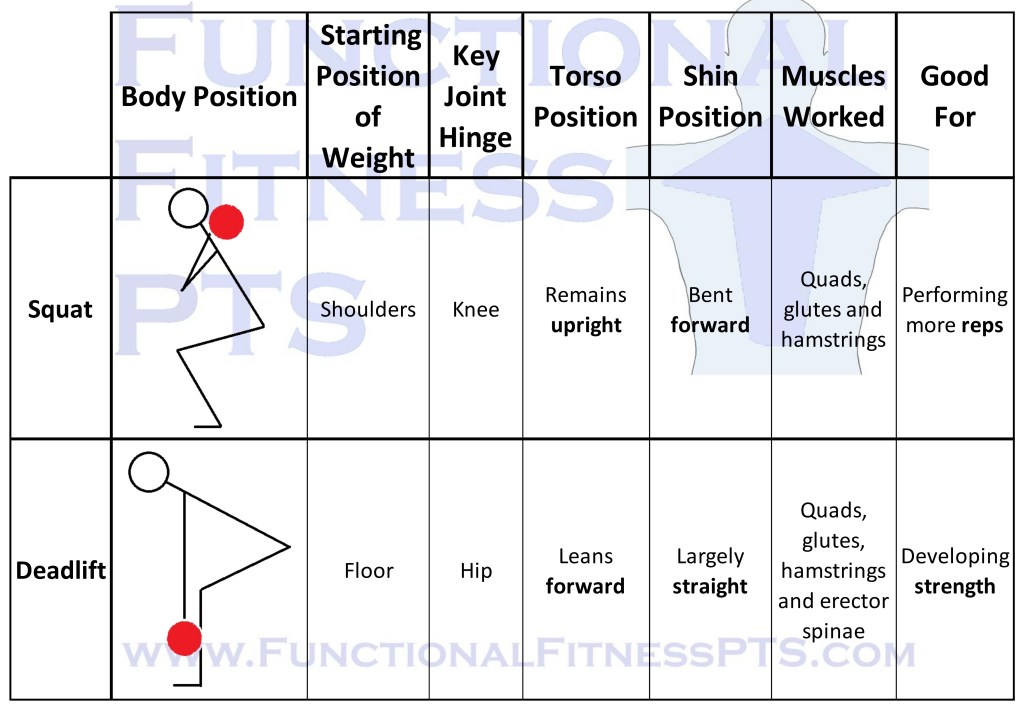
Download this table here.
 Functional Fitness PTS