The endocrine system is introduced at Level 3 and, like the nervous system, it maintains homeostasis, or balance, within the body.
This involves regulating things like body temperature and blood sugar levels by responding when they change.
However, whilst the nervous system uses fast-acting electrical signals, or impulses, the endocrine system is slower and uses chemical messengers called hormones to carry messages.
Positive and Negative Feedback Loops
The endocrine system maintains homeostasis through what are called feedback loops. There are positive feedback loops and negative feedback loops, both of which control the levels of different things in the body, such as blood sugar:
- Negative feedback loops bring levels back to normal.
- Positive feedback loops raise things above their normal level.
(Some sources oversimplify this by claiming that negative feedback loops reduce levels of things whilst positive feedback loops increase them; however, this isn’t quite right. If blood sugar is too high then it is lowered by a negative feedback loop, but if blood sugar is too low then it will be raised by a negative feedback loop. A negative feedback loop can raise or lower levels of something, but in either case this is in order to return the levels to normal. See the bottom of this page for a source confirming this.)
This picture illustrates this by looking at blood sugar levels. You’ve probably heard of insulin, which is released to lower blood sugar after you’ve eaten, but it also has a lesser-known counterpart, glucagon (GLUE – kah – gone), which is released in order to increase blood sugar if you haven’t eaten for a while.
So, if your blood sugar is too high then insulin is released to lower it whereas if your blood sugar is too low then glucagon is released to raise it:
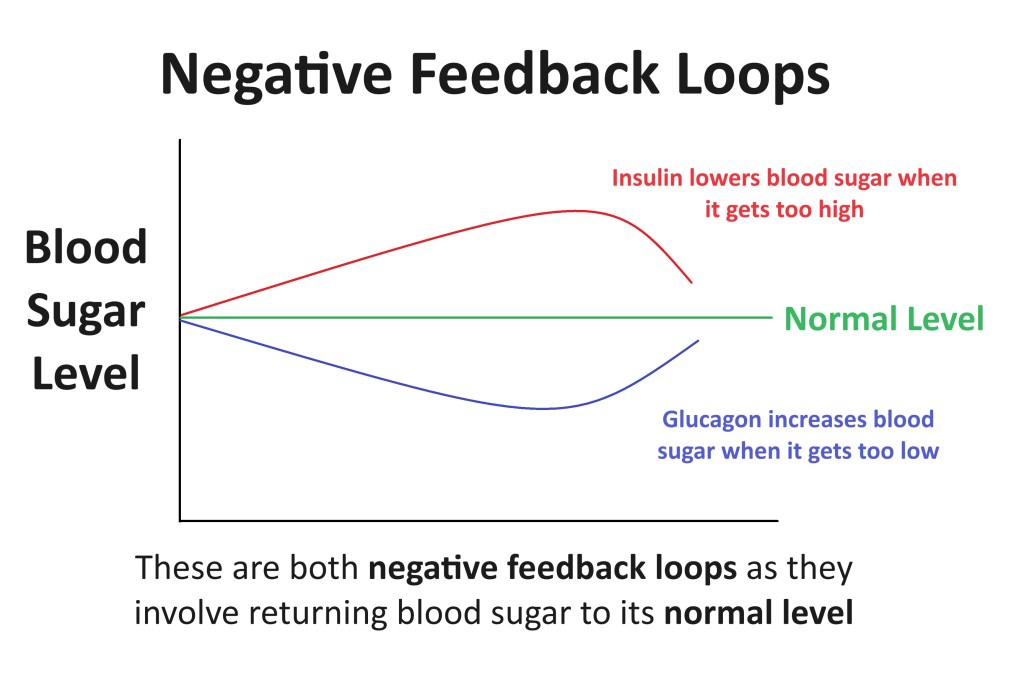
However, these are both negative feedback loops, as they both return the body to homeostasis by bringing blood sugar back to its normal level.
Positive feedback loops, by contrast, raise things above their normal levels. This is usually to assist with a particular bodily process such as blood clotting, where an increased number of clotting agents is released until the wound has sealed up.
Another example is childbirth, where oxytocin is released in order to increase the number of contractions.
This also illustrates how in positive feedback loops the bodily process continues to cause more of the hormone to be released for as long as necessary: oxytocin is released, which pushes the baby towards the cervix, which stimulates the cervix to release even more oxytocin, a looping process that does not stop until necessary, ie when the baby is born:
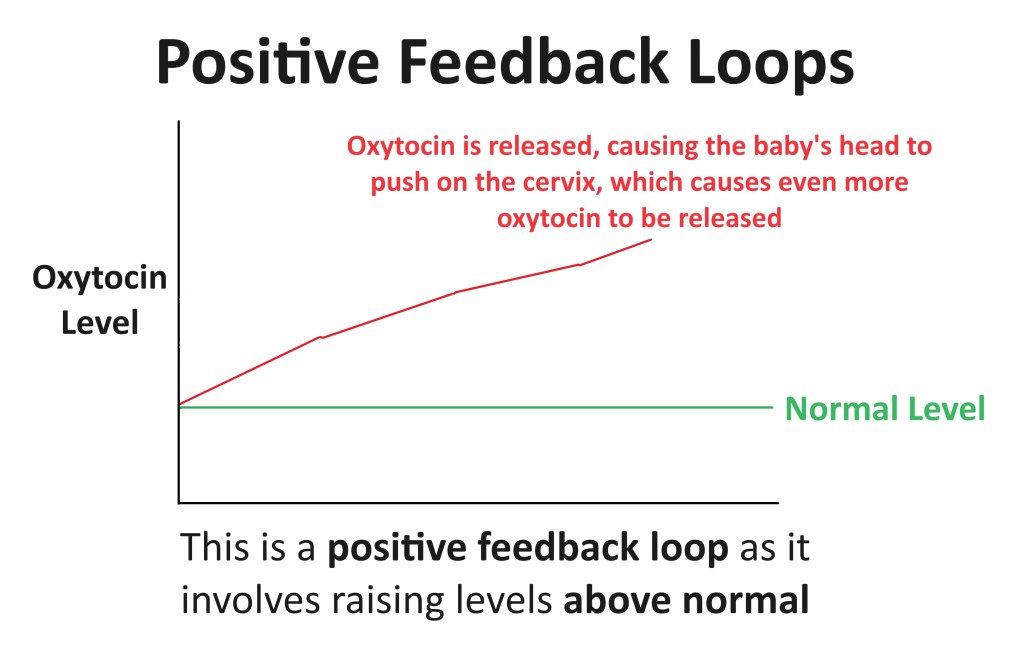
Therefore, both negative or positive feedback loops can raise levels of something, but negative feedback loops do so in order to return it to normal (because it was too high or too low) whilst positive feedback loops do it in order to raise it above normal levels (such as to assist with a particular process such as childbirth).
Hormones
Hormones are released into the blood in small amounts, and travel in the bloodstream to their intended destination.
Types of hormones include:
- Steroids, which are slow acting and long lasting, and include oestrogen and testosterone.
- Peptides, which are fast acting and short lived, and include insulin.
Hormones are secreted by endocrine glands (also known as ductless glands) and each perform a particular function. They’re all summarised in the table below:
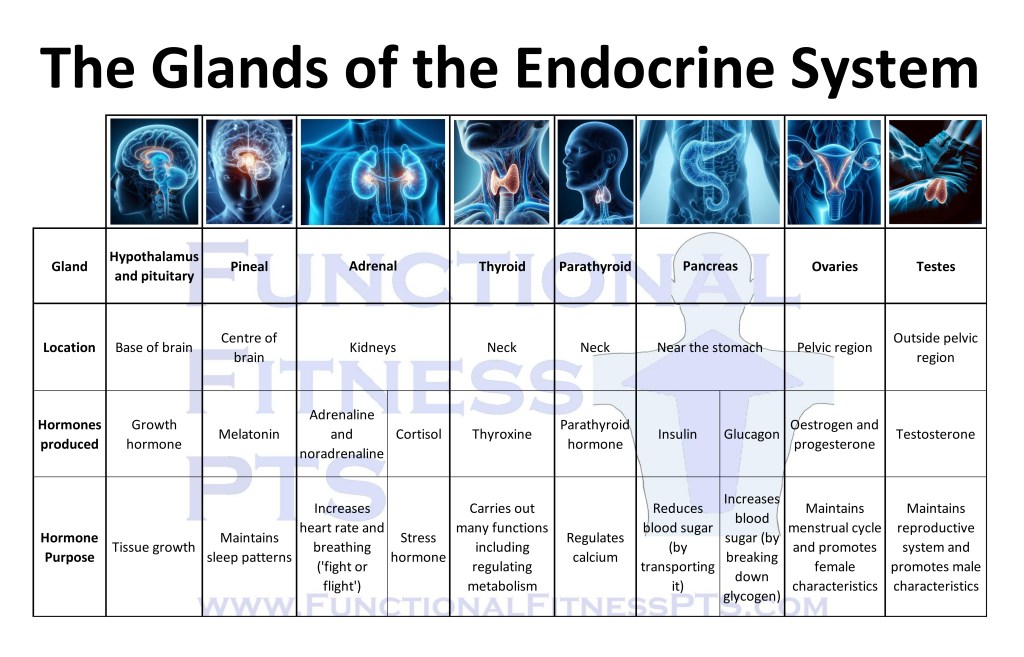
Available to download here.
(Sorry, what’s that? You think the picture of the testes looks a bit suspect? Well, sit down, for we have a tale to tell! The truth of the matter is that the images in this table were generated using the fairly fabulous Bing AI image creator tool. Except, when we tried to produce legitimate, anatomically correct pictures of the testes, this artificial ‘intelligence’ system decided we were abusing it by attempting to generate nudey pictures, so wouldn’t create them for us! We tried many terms including ‘human pelvis’ and ‘male thighs’ but, time and time again, Bing decided we were trying to create filth. So, in the end, we created a picture of ‘male human legs’, which you can see was generated to include a pair of shorts, then drew a pair of balls on ourselves! AI, huh! Why, you could even say the whole business made us a bit ‘testy’!)
Finally, here’s a source confirming that negative feedback loops return levels to normal by either raising or lowering them (rather than only reducing the level of something). It’s a BBC revision guide, so if this is wrong then a whole generation of students are going to fail their exams!:
 Functional Fitness PTS