
There are a number of excellent reasons why a personal trainer should have a good awareness of the spine; it’s something that’s involved in just about every exercise you can think of, so having an understanding of how it works and, most importantly, how to avoid damaging it are of vital importance.
So, first of all, let’s look at the structure of the spine. The first myth of which you should immediately disabuse yourself is the whole idea of having a ‘straight back’. You may have had teachers shout ‘keep your back straight!’ if they saw you slouching at your desk, but they couldn’t have been more wrong in telling you that because, quite simply, the back isn’t straight and never should be.
The spine, when viewed from the side, should be ‘S’ shaped, which allows the weight of the body to be evenly distributed. If the spine were straight then the very bottom of it would end up taking all the weight on its own, which would cause all sorts of problems.
The Five Sections Of The Spine
The spine is comprised of 33 bones called vertebrae, which are grouped together into five sections. The reason why it’s useful to know these will become apparent later, but for now let’s go through them. From the top, the sections of the spine are:
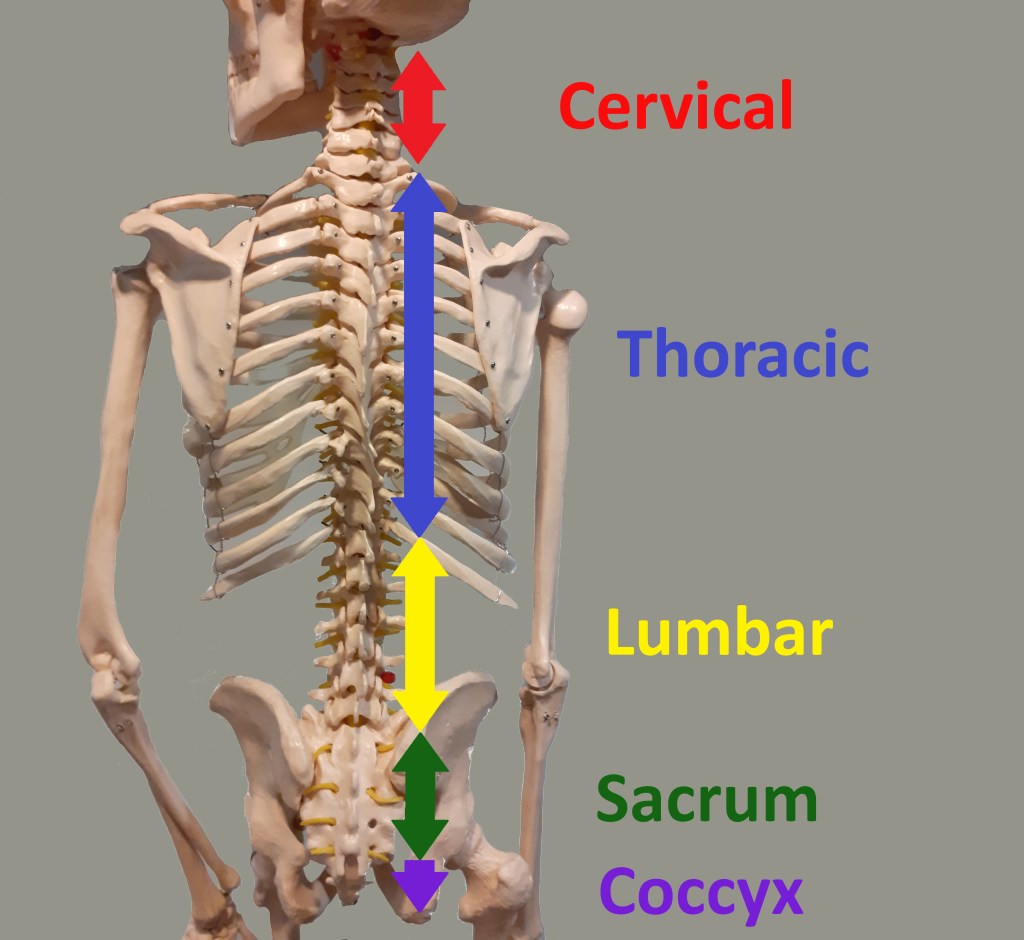
Cervical (comprised of 7 vertebrae)
These are the vertebrae that make up the neck.
Thoracic (12 vertebrae)
These are the vertebrae that make up the upper back, and are also where the ribs attach.
Lumbar (5 vertebrae)
These vertebrae make up the lower back.
Sacrum (5 vertebrae)
These vertebrae are fused together, and attach to the hip bones.
Coccyx (4 vertebrae)
Also known as the tailbone, the vertebrae in the coccyx are also fused together.
How To Remember The Sections Of The Spine
I think we can all agree mnemonics can be useful, which is why we came up with one.
In order to remember this:
CERVICAL THORACIC LUMBAR SACRUM COCCYX
Think of:
CURVE THE LONG SPINE CAREFULLY
And now here’s a useful diagram that brings these together:
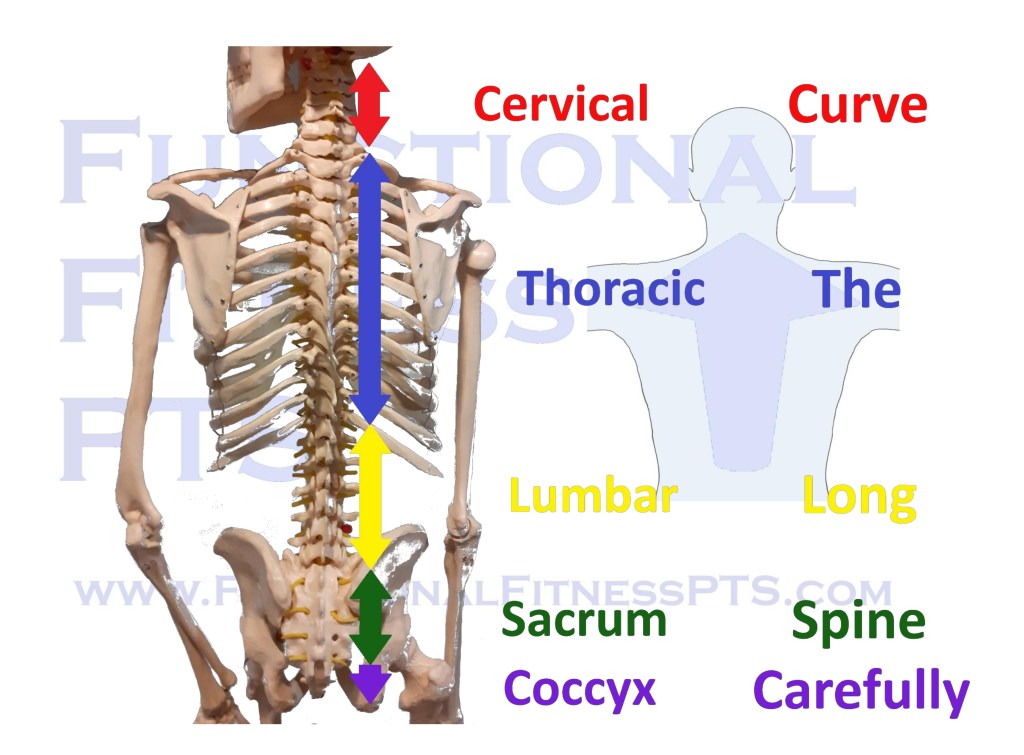
I like to think this is useful because the word ‘curve’ is close to ‘cervical’, so should help you to remember not just the first letter but also the whole word. I’ve really tried to come up with a mnemonic in which each word closely matches the word in the original list, but haven’t quite got there yet. Would it help you to recall the sections of the spine if you remembered them as Curve Thor’s Lumpy Sacred Cockerell? If it would then please let me know and I’ll update it…
How To Pronounce These Words
Here’s the pronunciation for each section; the part in capitals is the syllable that’s emphasised:
Cervical: SERVE – ick – ull
Thoracic: thur-RASS-ick
Lumbar: LUM – buh
Sacrum: SAY – crum
Coccyx: COCK – six
The Range Of Movement Of Each Section Of The Spine
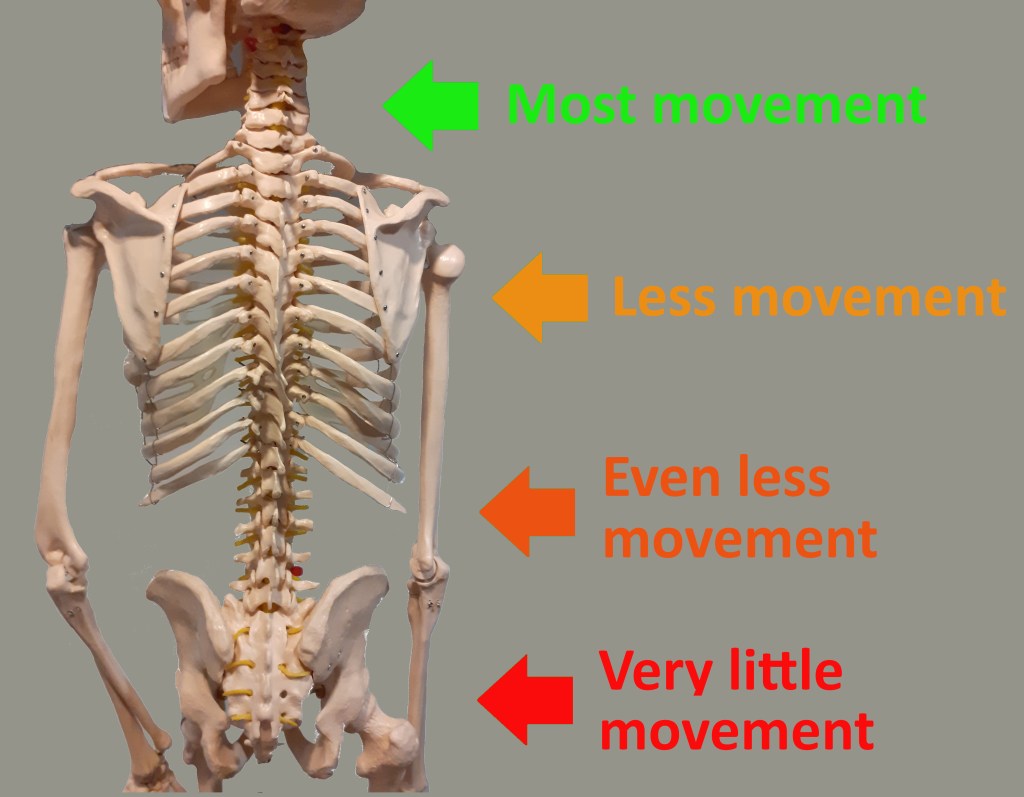
And now you’ve memorised the sections of the spine you need to learn about how much movement each one of them allows.
Fortunately, it’s pretty easy. All you need to remember is that the top of the spine (the cervical) has the most movement, with this then decreasing as you go down until there’s virtually no movement at the bottom (the coccyx).
So the top has the most movement and the bottom has the least. Like this:
Why It’s Useful to Know the Sections of the Spine
So, now we’ve looked at the sections of the spine, why might knowing them be useful to a personal trainer? Well, there are many exercises that make reference to sections of the spine and their correct positioning when discussing proper form.
For example, when performing a squat you may hear advice to have some ‘cervical movement’, which just means the neck shouldn’t be rigid when performing the move, and should instead move slightly as you squat up and down. (A good way to ensure you do this during a squat is to fix your gaze on a point in the distance and keep it there for the duration of the move).
Or when performing a bench press you may hear advice about ‘maintaining a lumbar curve’; what this means is that you should keep the natural curve in your lower back rather than pushing it forward/upwards or flattening it against the bench.
Or you may see references to ‘maintaining a neutral spine’. This is the modern version of being told to ‘keep your back straight’, and just means that you should keep the natural curves in your spine when performing a move. It’s often used in instructions for performing an exercise where you’re standing up, such as a bicep curl or lateral raise, in order to ensure your body’s weight is evenly distributed along the spine as you carry out the move.
So there we have the five sections of the spine, as well as how it should be best positioned in order to efficiently carry the weight of the body. But what happens if your spine doesn’t quite fit this idea of how it should be? Well, that’s called a postural deviation, and we’ll look at those in the next article: The Three Main Postural Deviations
 Functional Fitness PTS