The Functional Fitness Programme is a comprehensive exercise system with a number of aims including:
- Improving overall health including cardiovascular fitness and blood pressure as well as maintaining a healthy weight.
- Improving functional strength and increasing muscle tone in order to help with day-to-day activities and promote healthy ageing, by working all the major muscles in the body.
- Creating balance in the body, including ensuring both legs are equally strong by training them together as well as separately, that the core is worked from all sides and that opposing muscles such as biceps and triceps are worked equally.
- Practising and developing functional movement, again to help with day-to-day life, and with an emphasis on mobility, balance and stability.
- Increasing your range of movement by getting the body to move naturally, with joints and muscles encouraged to move in all the directions they are meant to whilst undoing the damage and limitations caused by everyday life.
- Creating a strong foundation upon which fitness can be built, such as by developing a strong core, legs and upper body.
The Functional Fitness Programme uses a comprehensive range of exercises, equipment and training systems to achieve its aims, including:
- Using free weights, resistance machines and bodyweight moves to improve muscular strength, with an emphasis on lean definition that is achieved by working the slow-twitch muscle fibres using slow and controlled movements.
- Using a range of training systems for resistance moves, such as opposing supersets, where one group of muscles is worked before the opposing ones are. Examples of this include alternating between bicep and triceps moves or performing the lat pull down then the shoulder press. This not only saves time but helps ensure that opposing muscles are worked equally.
- Working the muscles and joints from multiple angles in order to improve range of movement and ensure muscles are worked comprehensively, such as by working the lats with both lat pull downs and rows, or by working the legs with squats, lunges and step-ups.
- Performing cardio work using interval training systems such as Tabata and HITT, meaning that more work can be carried out in a shorter space of time, in a way that promotes EPOC, where the body continues to burn fat after the session has finished.
- Using equipment such as the BOSU ball to improve balance and core stability and the mobility rod to develop shoulder flexibility and good posture.
The session structure is as follows:
First there is a mobility warm up, to mobilise the joints and muscles and raise the heart rate, then a major muscle group is worked, then the arms are worked, then the core, then there is balance and stability work, then cardio, then comprehensive static stretching.
There are two session plan structures, which are performed on different days and alternated between, where the muscles worked are:
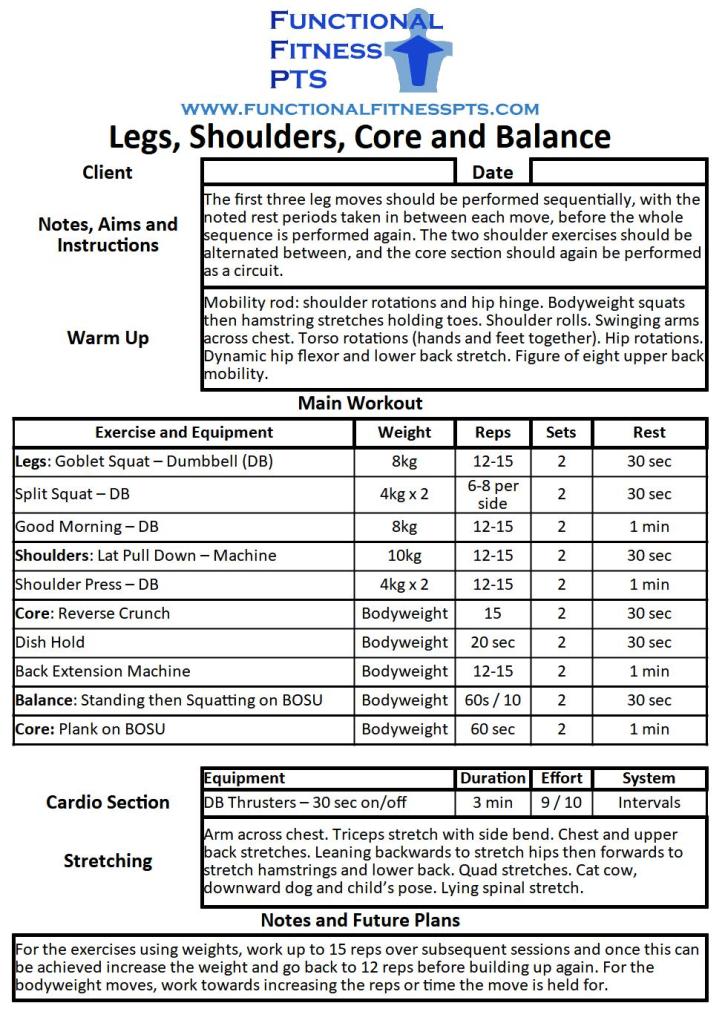
Plan 1: Legs, Shoulders, Abs and Lower Back
Plan 2: Chest and Back, Biceps and Triceps then Obliques
These plans can be followed 2-4 times per week.
The sessions get increasingly more challenging as the plan progresses, so as to force the body to keep adapting, using methods such as:
- Introducing new moves that work the same muscles but in different and more challenging ways, such as by replacing the crunch with the V-sit.
- Bringing in new training systems such as tri-sets and Tabata.
- Working up to performing challenging moves such as the press up or pull up, by using other exercises and training systems to strengthen the muscles that will be used.
When you subscribe to the programme you will receive a copy of the plans, including links to instructions on how to perform each move, which will be updated whenever the weights are increased so that you’re always using the right ones, like this:
If this programme is of interest then you can subscribe to it and get new plans each month.
 Functional Fitness PTS