The Functional Strength Programme is a comprehensive exercise system with a number of aims including:
- Improving functional strength and increasing muscle in order to help with day-to-day activities, by working all the major muscles in the body.
- Ensuring all muscles are worked evenly and equally using comprehensive workout plans, so that there are no strength imbalances or weaknesses in the body.
- Improving overall health including cardiovascular fitness and mobility.
The programme uses the principle of progressive overload to increase strength and muscle mass, which it does by:
- Gradually and safely increasing the weights being lifted over time, so as to keep challenging the muscles.
- Introducing new moves and training systems as the programme develops, which keep the body guessing, forcing it to adapt, and prevent plateaus from happening.
- Including stretching, cardio and mobility so as to assist with overall fitness and range of motion, in order to help strength and muscle development to progress.
The programme achieves this through a series of phases, each lasting 6-8 weeks, and which vary the moves and training systems so that the body and muscles continue to be challenged:
- Phase 1: Here, the main aim is muscular endurance, or getting the muscles used to being under tension for longer periods so as to lay down a foundation upon which to build strength and muscle, along with ensuring the body is moving within its full range of motion. A full-body workout plan is carried out 2-3 times per week, in which all the major muscles are worked, using training systems including circuit training and time under tension.
- Phase 2: Now the major muscles of the body are split into two workout plans, which are alternated between, allowing muscles to be targeted more frequently and with greater intensity, and which are carried out 3-4 times a week. The aim is still muscular endurance, but supporting muscles are now being strengthened more in order to prepare them for the next phase, and new training systems are introduced including supersets and tri-sets.
- Phase 3: A two-way plan is still followed, but now it is split into a leg day and an upper body day, the plans for which are alternated between and followed 3-4 times per week. There is now a focus on hypertrophy, or the increasing of muscle mass, which is achieved by targeting the bulkier Type II muscle fibres using explosive lifting, as well as by employing more challenging training systems such as synergistic supersets, where a compound move is performed followed by isolation exercises targeting supporting muscles, and drop sets, where a muscle is repeatedly worked to failure with no rest periods. The deadlift is now introduced, and the pull-up is worked towards using a range of training systems and exercises.
- Phase 4: Three plans are now followed, in 3-4 sessions per week, one focusing on legs, one on back and biceps and one on chest and triceps, with core moves split between them. This allows each muscle group to be worked with even more intensity than before. Hypertrophy is still the aim, and this is achieved by introducing even more challenging training systems including giant sets, synergistic tri-sets and tempo training.
- Phase 5: There is now a return to using two plans, an upper body plan and a leg plan, which are alternated between and followed 3-4 times per week. Hypertrophy is still the aim, but there is also a return to muscular endurance. One of the new training systems is antagonistic supersets, where a compound move is performed before isolation exercises are used on opposing muscles; an example of this is a bench press followed by a bicep curl. Muscles are also worked from different angles more, with a focus on the incline bench press rather than the flat version, and new exercises include cable flyes, cable woodchops and Biceps 21s.
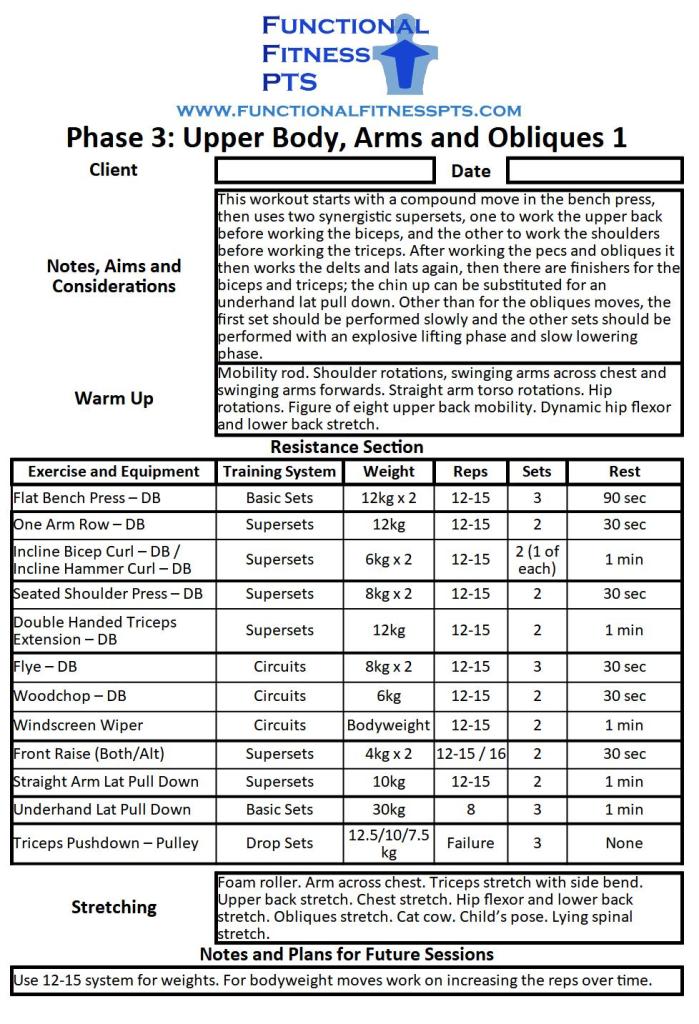
When you subscribe to the programme you will receive a copy of the plans, including links to instructions on how to perform each move, which will be updated whenever the weights are increased so that you’re always using the right ones, like this:
If this programme is of interest then you can subscribe to it and get new plans each month.
 Functional Fitness PTS