
Okay, if you’ve passed Level 2 and are now doing Level 3 you’ve probably noticed that a lot of the syllabus reiterates what was covered at Level 2 before adding a few new things. And the nervous system is the perfect example of that. First of all it goes over what you learnt at Level 2 (and if you’ve forgotten it already, there’s a handy guide here: The Nervous System – Level 2).
Then it adds a few new things, chiefly the difference between afferent and efferent nerves then the four types of sensory receptors.
Afferent and Efferent Nerves
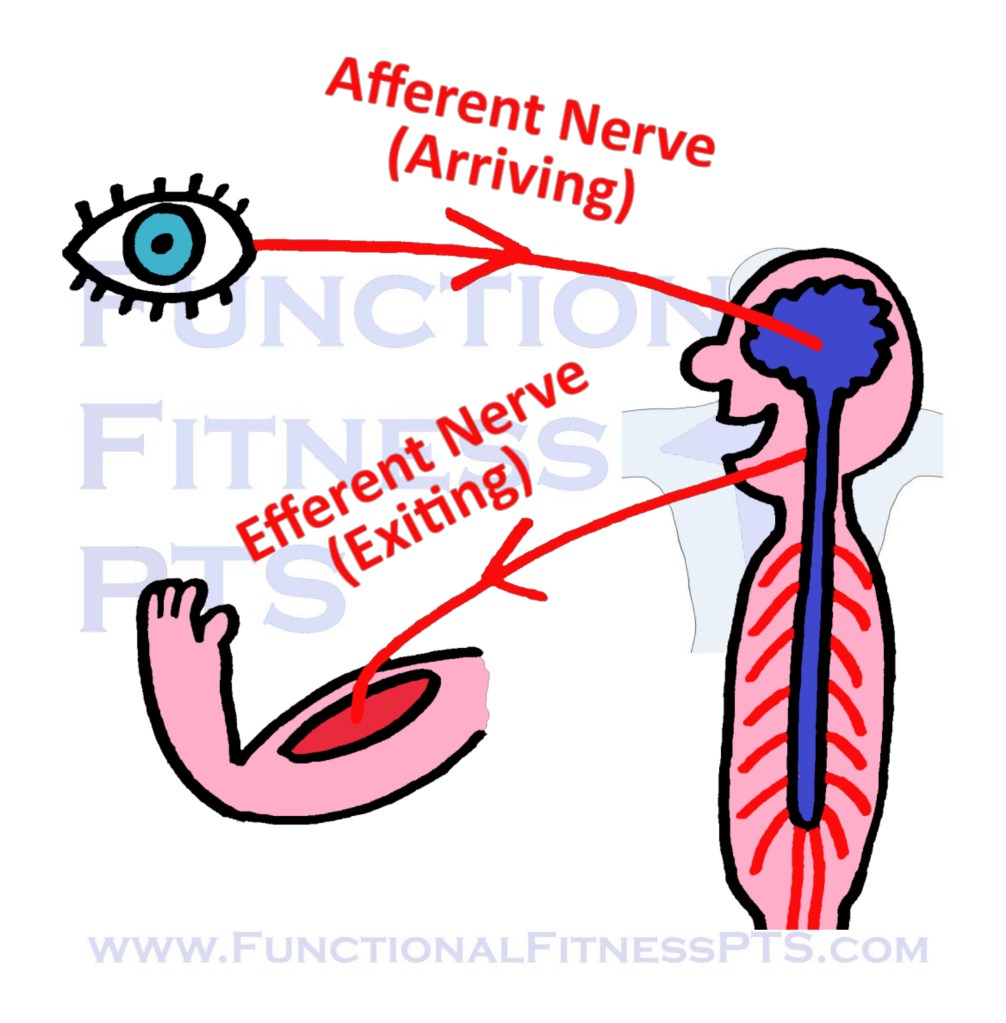
These are the nerves that carry electrical signals (impulses) either towards or away from the central nervous system. The way to remember the difference is:
A: Afferent Nerves are how the impulses arrive at the central nervous system.
An example is a sensory neuron carrying information from the eye to the central nervous system.
E: Efferent Nerves are how the impulses exit the central nervous system.
An example is a motor neuron carrying information from the central nervous system to the skeletal muscle.
Four Types of Sensory Receptors
Sensory receptors send signals to the central nervous system from around the body (so must use afferent nerves) and, fortunately, their names help to tell you what the information they send relates to:
Chemoreceptors send signals about changes to chemical levels.
Thermoreceptors send signals about changes to temperature, like a thermometer.
Baroreceptors send signals about changes to blood pressure, so think B for blood and baro.
Proprioceptors send signals about changes to the body’s position, so remember P. (Pronunciation: PRO – pree – oh – sep – tuh)
And to help you visualise this, here’s a handy diagram showing you how all these fit into the nervous system:
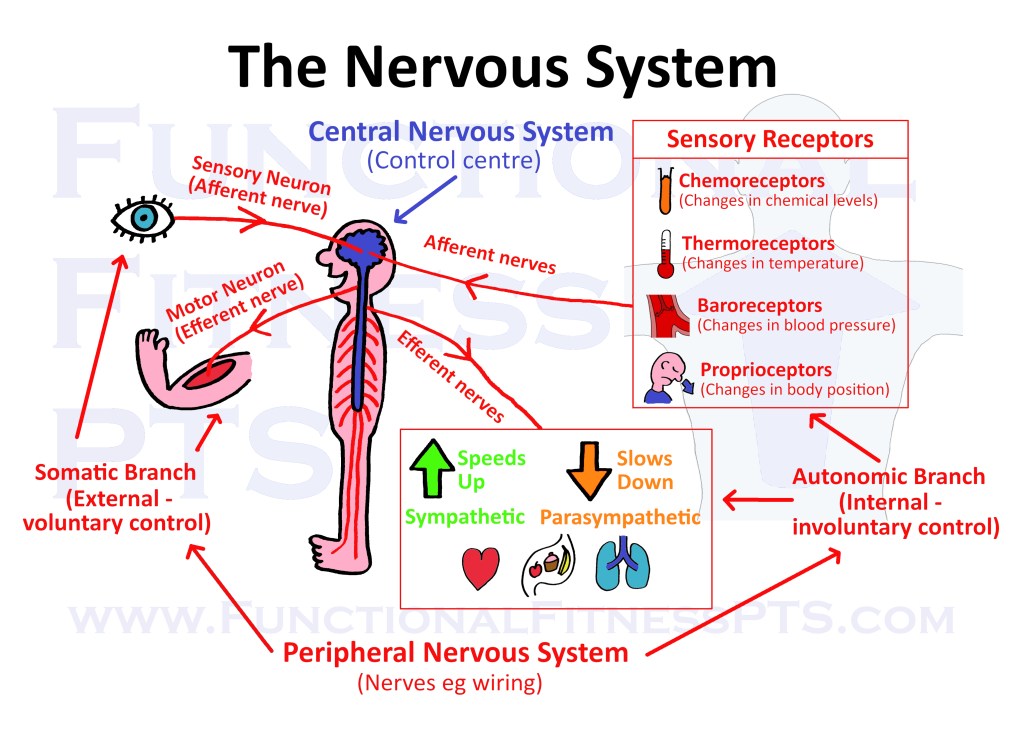
You can download this diagram here. But if you prefer a text based table, we’ve got one of those too. You’re welcome…
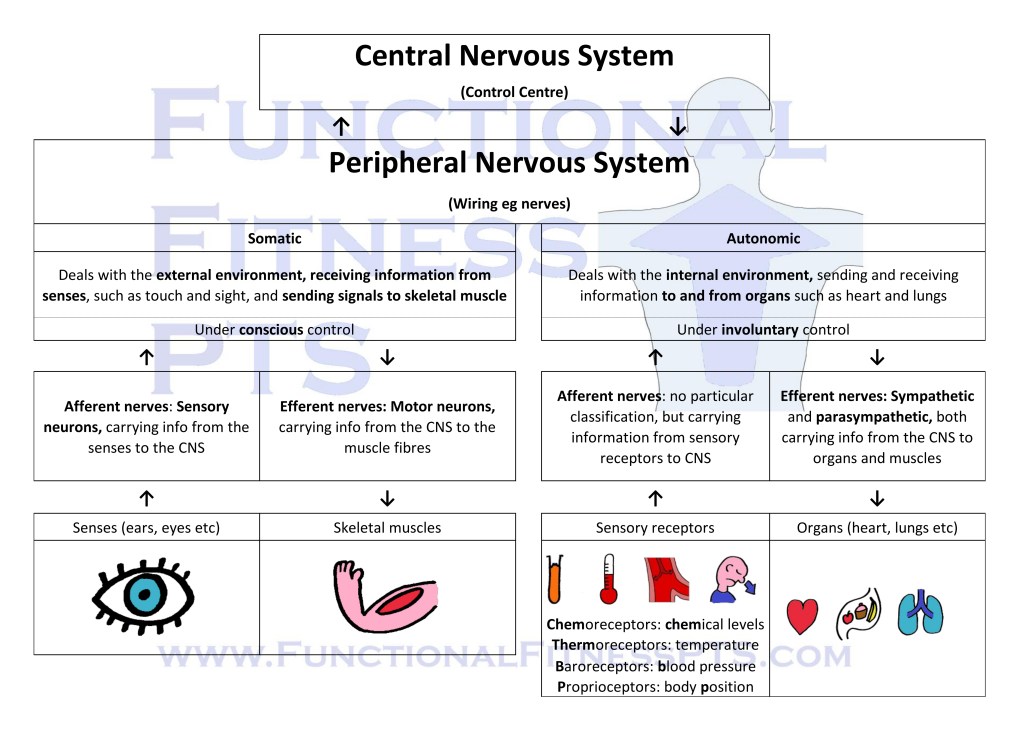
Got all that? Good! Now it’s time to look at two types of proprioceptor: Muscle Spindles and Golgi Tendon Organs
 Functional Fitness PTS