
When you first encounter energy systems either in the Level 2 manual or during a lesson on the topic you may feel like you’ve travelled back in time to chemistry class and find yourself thinking ‘crikey! That’s a lot of science! Do I really need to know all this?!’
Well, whilst it’s probably fair to say that the Level 2 and Level 3 syllabuses do often go into scientific subjects in a level of detail that won’t be of much practical value to a personal trainer, in the case of energy systems this is for a good reason, as they’re an excellent example of how the science genuinely can be put to practical use to help a client achieve their training goals. So, yes, you really do need to know them!
Put simply, studying the energy systems tells us how the body produces energy in different ways, and how it does this depending on the type of activity that’s being carried out.
The two main reasons why understanding the energy systems is tremendously useful for personal trainers are:
- The energy system used by the body for a particular type of exercise will depend on the duration and the intensity of the activity in question. Therefore, in order to help a client improve in a particular area, whether that’s endurance running or explosive power, you need to know which energy system that activity uses and focus on developing it.
- The three energy systems all use different fuel to power the type of activity they’re used for. Knowing this can not only help you ensure that your client is adequately fuelled up for the type of activity they’re about to undertake (such as by giving them quick-release carbs if they’re doing explosive activities or slow-release carbs if they’re doing endurance work) but also assist with fat loss by helping you choose activities that will primarily use fat as fuel.
The Three Energy Systems
The three energy systems the body uses are:
The Phosphocreatine System
(Also known as the PC system or the ATP-PC system)
This energy system is used for short, explosive types of activity such as the 100m sprint, or lifting a heavy weight for five fast reps.
It uses creatine phosphate as fuel (hence its name), which is stored in the muscles but runs out quickly. This is why the activities it powers can only be performed for short periods, usually no more than 10-15 seconds.
(However, it’s also worth noting that creatine supplementation can be used in order to improve performance when using this system; because creatine is the fuel used by the phosphocreatine system, giving the body more of it means it can work for longer.)
The Lactic Acid or Anaerobic System
This energy system is used for slightly longer duration activities performed at a slightly lower intensity, such as a 400m sprint or a set of 15 reps lifting a medium weight.
It uses glycogen as fuel, but does not use oxygen (hence ‘anaerobic’, or ‘without oxygen’). Glycogen is the body’s stored form of glucose, mainly stored in the muscles.
This energy system allows an individual to perform for 2-3 minutes. The point at which they are no longer able to continue arises due to a build up of lactate causing their muscles to cramp. Lactate is a by-product of this energy system, and once it has reached a certain level in the blood the individual will have to rest or slow down until levels have reduced before they are able to continue with the exercise.
(It’s also worth noting that there is some dispute regarding whether it is lactate or lactic acid that’s produced by this energy system. The term ‘lactic acid’ is more commonly used, but a number of credible sources say it’s more accurate to use the term lactate. It’s an ongoing discussion, but for now it’s worth bearing in mind that there is debate over this, as well as that this energy system is almost uniformly referred to as the ‘lactic acid system’ even if that’s not strictly accurate. (And that’s why the table at the end uses the name ‘lactic acid system’ but describes the by-product as ‘lactate’, okay?!))
The Aerobic System
This energy system is used for longer duration, lower intensity activities such as running a marathon or walking (as well as being used to fuel everyday bodily functions such as digestion and breathing).
It starts out using glucose as fuel before moving on to fat once the glucose has run out, but in both cases it also uses oxygen to produce energy (hence ‘aerobic’).
(When the body’s supplies of glucose have run out and the aerobic system is predominantly using fat as fuel, this is known as entering ‘the fat-burning zone’.)
Points To Bear In Mind About Energy Systems
Exam questions tend to focus on asking you what activities will use which energy system, so you might get ones asking you which system will be used during a 100m sprint (phosphocreatine), a 400m sprint (anaerobic) or a marathon (aerobic). If you want a more in-depth breakdown of which energy system you will be using when working at different levels of intensity then you might want to have a look at the article on the Borg Scale.
Another thing to bear in mind is how long each energy system allows you to work for; again, this ties in with the type of activity being carried out, as you can’t sprint flat out for more than about fifteen seconds, whereas you can run a marathon for hours (just as long as your cardiovascular fitness permits it). But the most common summary is as follows:
Phosphocreatine: 10-15 seconds
Lactic Acid or Anaerobic: up to 2-3 minutes
Aerobic: 3 minutes and above
Here’s a table summarising the main points of each energy system:
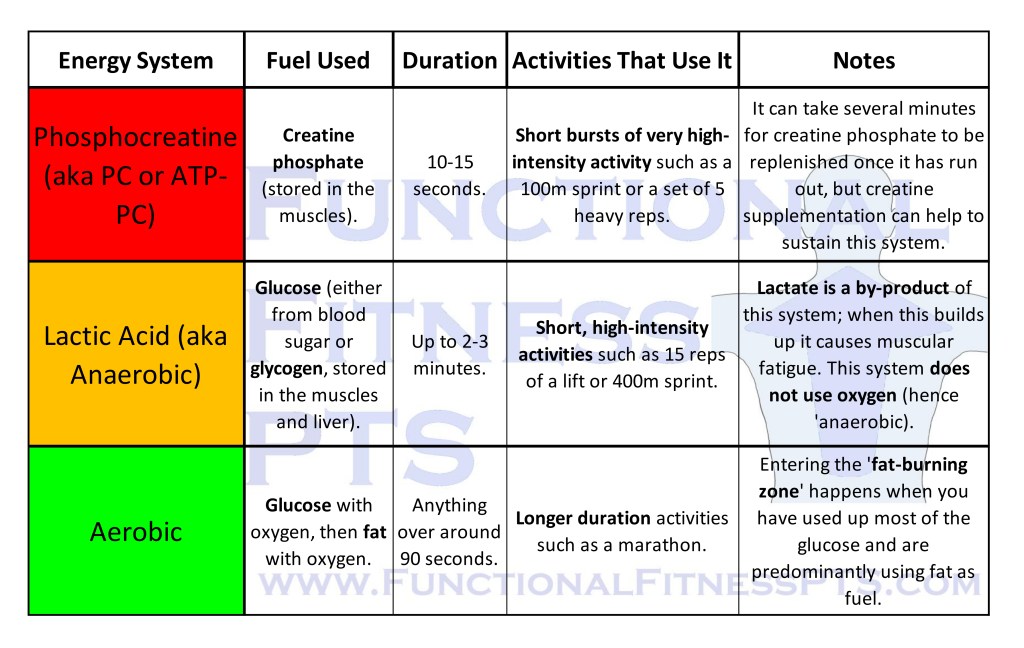
And if you want to learn more about how particular training systems utilise energy systems you may want to read this Level 3 article about Onset of Blood Lactate Accumulation.
 Functional Fitness PTS