You may have heard of isometric exercise or the benefits of focusing on the eccentric phase of a lift, but what do these things actually mean?
Well, here’s a handy table summing up the differences between isometric and isotonic moves, as well as the two phases that make up an isotonic move:
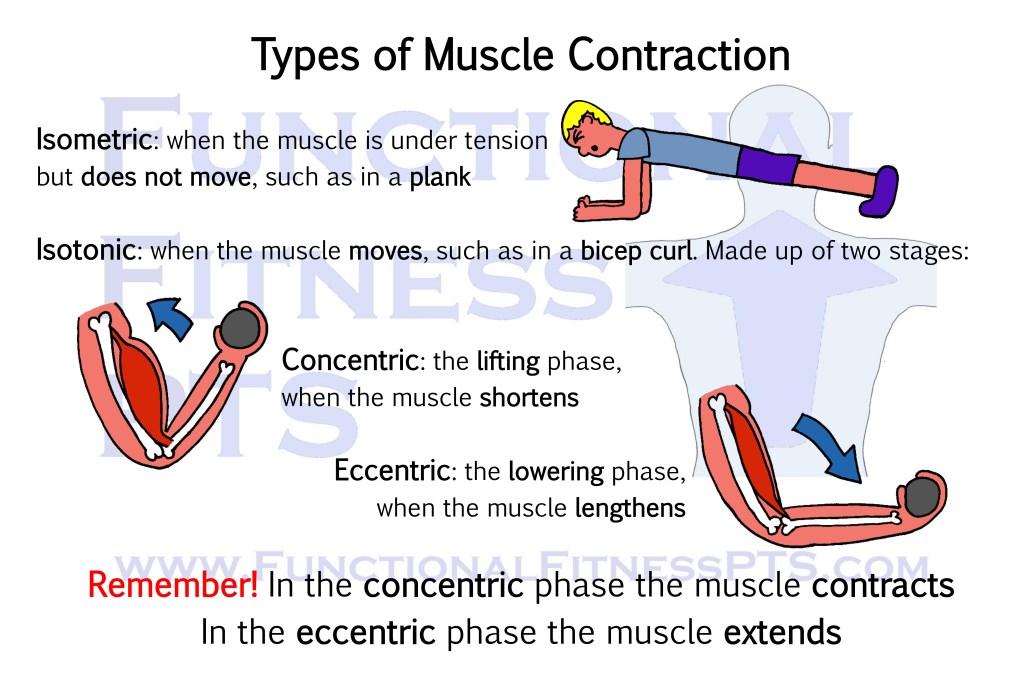
Just to clear up any confusion, a contraction usually refers to any time a muscle is under tension, even if it’s not moving. This explains why a plank is still an isometric contraction: the muscle isn’t moving but it’s still under tension.
However, in dictionary terms, ‘to contract’ also means to squeeze something or make it shorter, which is what happens to a muscle when you lift a weight. So whilst it may seem like the above diagram contains a contradiction, as it refers to all the moves as contractions as well as referring to the lifting phase of a resistance exercise as a ‘contraction’, this is entirely accurate (as well as hopefully helping you remember the difference between the two stages).
You can download this diagram here.
 Functional Fitness PTS