
Whilst it’s true that not everyone enjoys doing cardio, you really do need to find a way to include it in your overall fitness regime because it has benefits you won’t get just from doing weights, benefits that include not just improving your cardiovascular health but also helping with your mobility, balance and agility.
Furthermore, plyometric exercises such as box jumps work your fast-twitch muscle fibres in a way they won’t usually get worked in a weights session. Therefore, it’s a good idea to do some combination of weight training and cardio regardless of what your fitness goals are.
That said, it can be difficult to find ways to best combine the two, which is why in this article we’re going to examine how you can incorporate cardio into your existing workout schedule without making huge changes to it.
The best way to place cardio within your routine will depend on your fitness aims, so here we’re going to suggest a few different methods so you can decide which one will work best for you. Our suggestions include:
- Performing A Tabata Circuit at the End of A Weights Workout: this allows you to focus on lifting weights whilst also improving your cardio in a very time-efficient way.
- Doing Weights Workouts for Three Weeks Then Spending the Fourth Week Doing Cardio: this allows you to spend more time improving cardio whilst not being away from the weights room long enough for your progress to be affected.
- Alternating Between a Week of Weights Workouts and a Week of Cardio Workouts: this is a good way to strike a balance between increasing strength and muscle whilst also improving cardio and losing weight.
- Performing Cardio on What Would Otherwise Be Recovery Days: this allows you to focus on weights whilst fitting cardio in around your workouts.
Disclaimer: this article makes references to interval training, which involves exercising at a high intensity. Anyone new to exercise should seek clearance from their doctor before attempting interval training, and we recommend that you perform cardio at a lower intensity when you first take up exercise to ensure you are not over-exerting yourself, and only attempt interval training when you have reached a good level of fitness.
Performing A Tabata Circuit At The End Of A Weights Workout
It’s first of all worth noting that whilst you can do a light cardio section at the start of a weights workout as a warm-up, it’s better to save any proper cardio until the end of the session, mainly so you don’t tire yourself out then underperform during the weights section.
And a good form of cardio to do at the end of a session is Tabata, a form of HIIT (High-Intensity Interval Training) where you alternate between performing a short burst of high-intensity work and having a short rest period.
In the case of Tabata you do 20 seconds of work followed by 10 seconds of rest, eight times in all, for a total of four minutes.
There are a number of reasons why this is a good option for after a weights workout. First of all, it ensures your cardiovascular system is challenged in a way it usually wouldn’t be when you’re lifting weights and, secondly, because it only takes four minutes then it won’t significantly increase the length of your workout. Interval training is also believed to be a very efficient way to help with fat loss, where EPOC means you continue to burn fat after you’ve finished exercising.
Tabata is the name given to the training system, but you can apply it to all sorts of exercises; at a simple level you could use it when performing burpees, doing them for twenty seconds before having a ten second rest then repeating.
However, when you’re performing Tabata after a weights session it’s a good idea to choose an exercise to do that isn’t working the same muscles you’ll have already have exhausted. Some examples of this include:
- On Leg Day: use the Ski-Erg, because most of the work is done by the upper body whilst your legs do little more than bodyweight squats.
- On Chest Day: use the rowing machine, because you’ll be using the legs, which you didn’t work using the weights session, along with using the lats and biceps to pull the handle towards you, neither of which will have been the main working muscle groups during moves such as the bench press.
- On Back Day: try kettlebell swings, because most of the movement comes from the legs and hips whilst the weight is controlled by the deltoids, none of which will have been the main working muscles during the weights workout.
For more information on how to apply Tabata principles to these exercises, please see the guide below.
Doing Weights Workouts For Three Weeks Then Doing One Week of Cardio
This may be a hard sell, but you might want to consider spending every fourth week focusing on cardio. This is what’s known as an ‘active recovery week’, because whilst you’re not working at the same intensity as when you’re lifting weights, you’re still doing something; this can be cardio such as swimming or running or even other activities such as yoga, and the idea is that you allow your muscles a week to recover whilst also improving your abilities in other areas, chiefly cardio.
Furthermore, because you’re only away from the weights room for a week you won’t lose any of your gains and once you return to lifting weights you should still be able to use the same ones for the same number of reps as you could before the recovery week. Some people even report coming back stronger and fresher after a recovery week because their muscles have had more time to adapt and grow.
In terms of structuring your cardio week, it will depend on how many days you want to commit to it, but you might want to consider alternating between HIIT sessions (perhaps Mon/Weds/Fri) with something less strenuous and lower-intensity in between (Tues/Thurs), such as swimming. You could also go for a run at the weekend.
Furthermore, the cardio week can be used as an opportunity to reduce body fat, as you should find you don’t need to eat as much as when you’re trying to put muscle on. Therefore, you should be able to put yourself in a calorie deficit during this week, with a focus on prioritising protein and fibre over carbs.
Alternating Between A Week Of Weights And A Week Of Cardio
We catchily call this Week Of Gym, Week Of Trim, or WOGWAT for short. As the name suggests, you do a week of weight training, and eat appropriately to ensure you’re getting enough carbs for fuel and protein for recovery, then have a week where you focus on cardio as well as eating less. Amongst the benefits of this are that you’re never away from the weights room for more than a week, so don’t lose any of the progress you’ve made there, whilst also not being away from cardio for long either so continuing to improve with that too.
If performed with a certain amount of discipline it can be a good way to lose weight quickly, and even though you should aim to be in a calorie deficit (eating fewer calories than you burn), you only do this for a week before you return to doing weights and can eat normally again, making it easier than being in a deficit for a longer period.
In terms of the structure, you can do 3-4 weights workouts during the Week Of Gym, then for the Week Of Trim do things like running, swimming or HIIT (such as our Cardio Buffet Workout, which covers a range of interval systems). A good way to split this is to do HIIT and swimming on alternate days, as that places less strain on the joints.
Performing Cardio On What Would Otherwise Be Recovery Days
There’s less of a structure to this but, if you have the time, such as if you work or live near to a gym so can get there easily, the idea here is to fit cardio in wherever you can around your gym workouts.
For example, if you work out Monday, Wednesday and Friday then you could do cardio on the days in between, with swimming being a good option as it’s a low-impact activity that places little strain on the joints, and/or go for a run at the weekend. This means that whilst cardio isn’t your main focus, any time you do any it’s a bonus.
So now we’ve looked at how you can fit cardio into your existing workout structure, let’s take a moment to look at how to perform some common and useful types of cardio, chiefly the Tabata we mentioned earlier, as well as a way to apply the principles of interval training to swimming:
Some Ways to Perform Different Exercises Using Tabata
Just to reiterate, Tabata involves:
- 20 seconds of work
- 10 seconds of rest
- Performed 8 times, so for a total of 4 minutes
If you do have trouble keeping track of these short intervals, here are a number of ways to help you depending on which exercise you’re performing:
- Kettlebell Swing, Dumbbell Thruster or any other Free-Weight or Bodyweight Exercise
Because it’s difficult to look at your watch or phone whilst swinging a weight, a good way to perform Tabata whilst doing these moves is simply to position yourself so that you’re facing a digital clock.
Yes, you could set an alarm on your phone, but using this system is even easier as the clock being in constant sight means you can see when to stop after 20 seconds and when to start again when the seconds on the clock display 30 or 00, and also means you can see how long you have left in each interval.
- Ski-Erg or Rowing Machine
With the Concept 2 models, which are found in a lot of gyms, you can programme them for Tabata so that the display tells you how long to perform the move for and how long to rest for.
To do this, choose the following options on the screen: Select Workout – New Workout – Intervals – Intervals: Time
You’ll then see this screen, where you should change the top number to 20 and the bottom number to 10, then confirm by pressing the button above the Menu button:
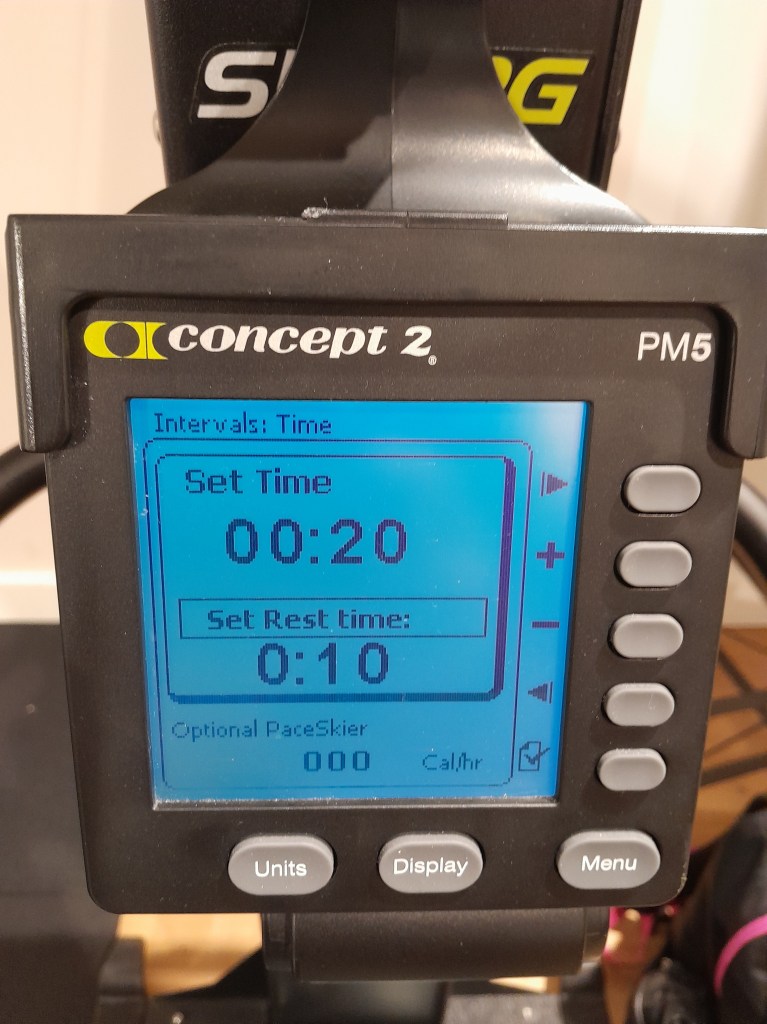
As soon as you start the exercise the first 20 seconds will start counting down, and once you get to the end of that there will be a 10 second countdown until it’s time to start again. Once you’ve completed eight intervals then you’re done.
- Exercise Bike
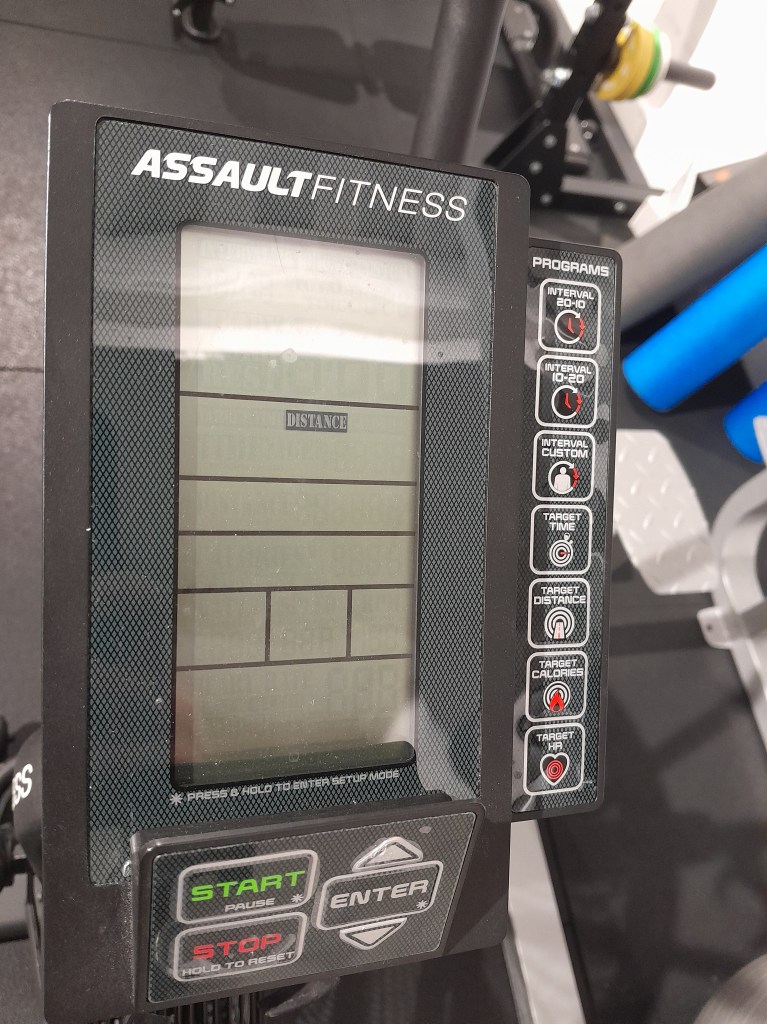
This will again depend on the model, but the popular Assault Bike model found in most gyms actually has a pre-programmed Tabata setting.
Simply press the ‘Interval 20-10’ button at the top right and press start, and the bike will then tell you when to work and when to rest.
How to Perform Interval Swimming
More people should swim, because it’s not only a great cardio workout but also takes the weight off your joints, making it a useful activity to do as part of active recovery, on days or weeks in between weights sessions.
It also allows you to work within a wide range of intensities; if you’re new to it then you can perform it at a slow and steady rate, but if you’re at a more advanced level and want to swim in a more efficient way then you may want to try interval swimming.
Whenever people talk about interval training they almost always refer to applying it to dumbbell or kettlebell exercises or machines like the Ski-Erg or rower, but what you very rarely hear people talk about is applying those same principles to swimming, which is a shame because it’s an activity that lends itself to interval training very well, mainly because you can alternate between a fast lap and a slow lap, which obviously means that the distance you do in both intervals will be the same.
So, a good way to perform interval swimming is as follows:
- Warm Up: swim for around five minutes at a moderate level (this may be ten or twenty lengths depending on the length of the pool), using a range of strokes including front crawl, back stroke and breast stroke, so as to get the limbs and joints moving in a range of directions.
- Main Interval Section: alternate between swimming a length as quickly as you can and following it by a recovery length where you go more slowly.
- You may want to alternate the strokes so that the one you use in the quick length is different to the one you use for the recovery length in order to use different muscles. For example, if you perform the breast stroke for the quick length then you may wish to perform the back stroke for the recovery length (this has the added advantage of helping you get your breath back because your face is out of the water for the duration of the recovery length).
- Duration: I usually do 25-30 minutes, though it will depend on your abilities and the available time; if you do interval swimming after a weights workout you could do 5-10.
- Cool Down: once you have performed the intervals for as long as desired, swim for 3-5 minutes at a moderate level, varying the swimming strokes as you do so like you did during the warm-up.
So there we are! Hopefully the above was useful in terms of not just deciding where best to place cardio within your workout structure but also by suggesting some types of cardio to do, to say nothing of, well, hopefully motivating you to actually get round to doing it in the first place.
 Functional Fitness PTS