We should first of all say that it’s a very good idea to have a PT session when you first start going to the gym to introduce you to all the things you can do there but also, crucially, to show you how to do things safely. A lot of people think they can do it on their own and end up injuring themselves. Don’t let that person be you!
If you do want to work out on your own, however, here we’ve included two session plans that will suit a beginner. Each of them is a comprehensive, full-body workout, meaning they cover all the major muscle groups, and they’re both straightforward and safe, with no difficult or dangerous exercises.
One uses resistance machines and the other uses dumbbells and bodyweight. And they’re both good for improving your muscular endurance, which is a good goal to focus on when you start going to the gym.
(As usual, however, please read the disclaimer at the bottom of this page before proceeding with these workouts, as well as ensuring you warm up before and cool down after.)
Beginners’ Full Body Machine Workout
When you’re new to the gym it can be a good idea to learn how to use resistance machines. These are safer for beginners as they deliberately limit and control your range of movement, essentially keeping your body in place so you perform the moves correctly.
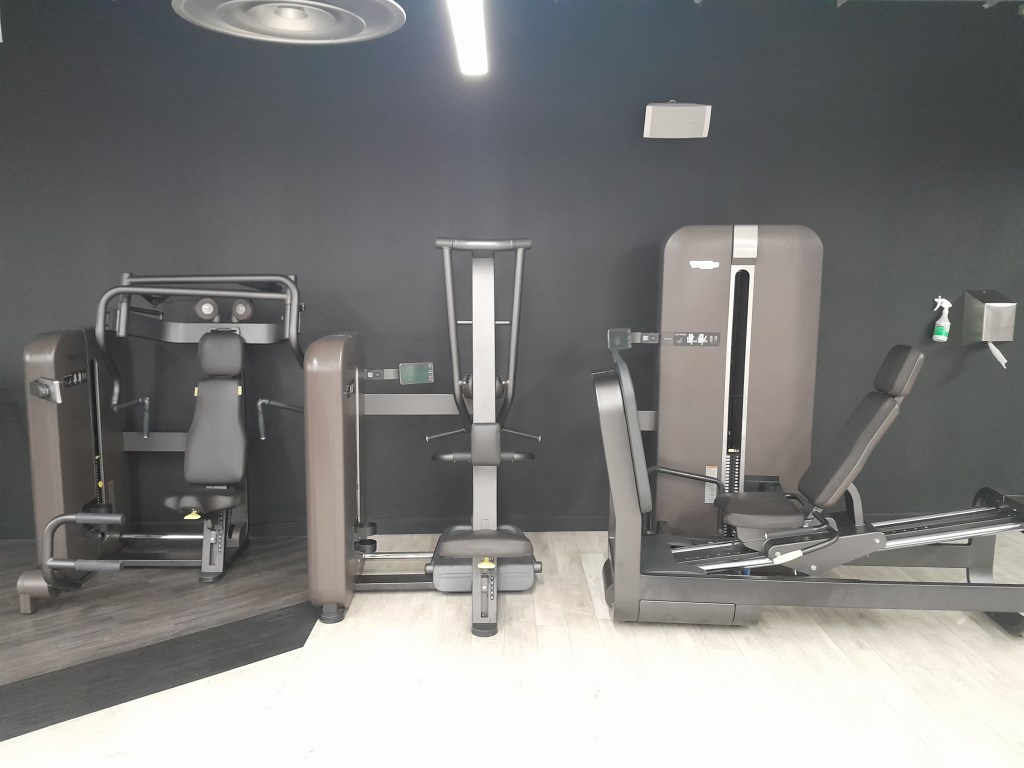
The workout plan is below. The moves are grouped together so that you perform opposing movements, such as using your upper body to push (the chest press) then using your upper body to pull (the seated row), and whilst it may seem like this workout doesn’t target all the muscles, as there aren’t any specific bicep or triceps exercises, the biceps are used in the row and the triceps are used in the chest press, so they do actually get worked.
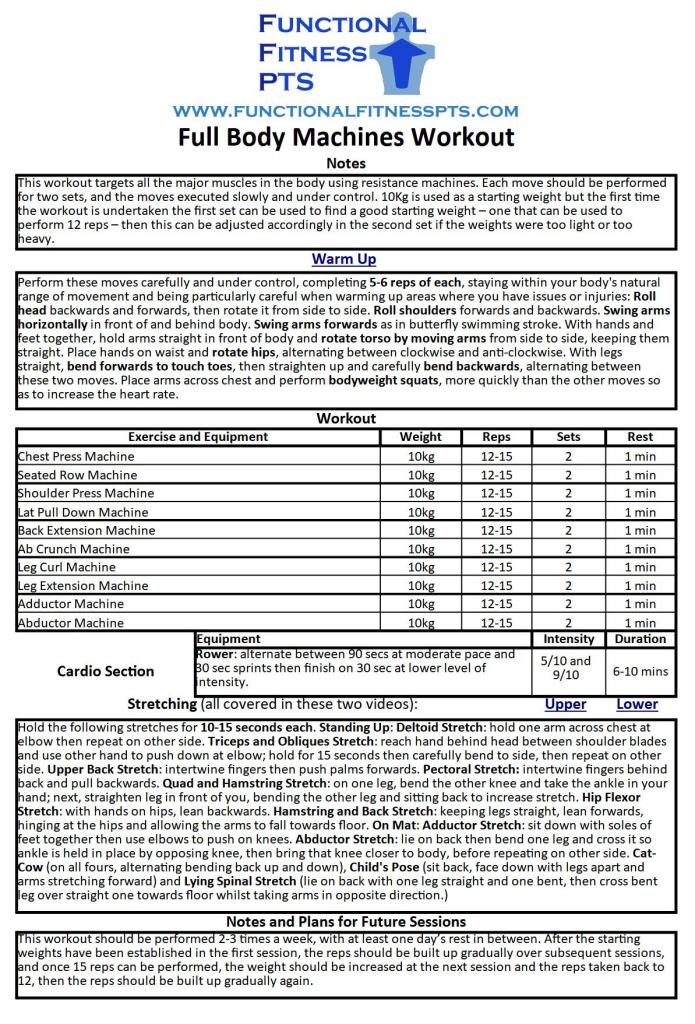
The key things to bear in mind here are:
- Make sure you warm up first. (You can watch a video on how to do that here.)
- Make sure you adjust the machines to fit your size. This includes moving the seat so you’re not too low or too high and ensuring any handles are adjusted so you’re not overextending your limbs. Machines usually have instructions on them, but someone in the gym should also be able to help you set them up correctly.
- Start off with a light weight. Once you’re comfortable performing the movement, try to find a weight that allows you to perform 12-15 reps before you start to struggle.
- Perform the moves slowly, carefully and under control, making sure you’re moving within your natural and safe range of motion.
- Perform two sets of each move; you can either do one move twice then the other move twice, or alternate between them until you’ve done both twice.
- Increase the weights once you’re finding the current ones too easy. Once you can perform 15 reps of a move then increase the weight the next time you do it, go back to 12 reps and start to build up to 15 reps again.
- Make sure you stretch afterwards. (Here are links to videos showing you how to perform upper body stretching and lower body stretching.)
This workout finishes with a cardio section using interval training, which is where you alternate between a high level of intensity and a lower one (or a period of rest), and is explained here:
In this case, you get on the rowing machine and alternate between 90 seconds at a pace that feels like an effort level of 5/10 and 30 second sprints at what feels more like a 9/10 level of effort.
However, if you’re new to the gym then just stay at the 5/10 level for the whole time whilst you gauge your cardio abilities.
You can do this workout 2-3 times a week with a least one day’s rest in between sessions, following the system of increasing the weights once you can perform 15 reps of an exercise so that you continue to improve.
Beginners’ Full Body Free Weights Workout
This workout uses free weights, in this case dumbbells, and also includes a few bodyweight moves. It’s slightly more challenging than the machine workout but encourages your limbs and joints to move more freely than they would when using machines, so helps with stability and mobility.

It’s comprised of two circuits that collectively work all the major muscles in the body, and to perform it you just need 3-4 dumbbells and a mat, meaning you don’t need much equipment or space; you can just get these things and set yourself down in a quiet corner of the gym to get on with it. Or you could even get the equipment yourself and perform this at home.
So, first of all, here’s the plan:
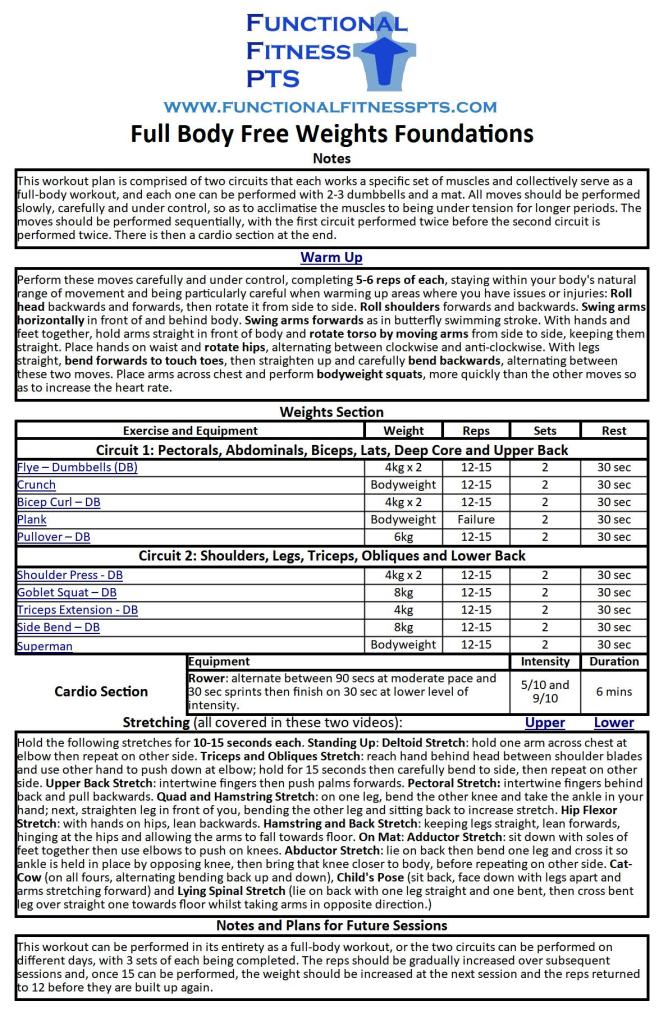
The key things to bear in mind are as follows:
- Make sure you warm up first. (You can watch a video on how to do that here.)
- Start off with light weights. Once you’re comfortable performing the movement, try to find a weight that allows you to perform 12-15 reps before you start to struggle. (The weights in the plan are suggested starting weights but you may need to use lighter or heavier ones.)
- Perform the moves slowly, carefully and under control, making sure you’re not overextending your limbs and are moving within your natural and safe range of motion. (The video below shows you how to perform them, but you can also find instructions here.)
- Try to lower the weights to a count of four, to maximise the time that the muscles are under tension for.
- Perform the moves in order, completing the first circuit once before repeating it, then do the same with the other circuit. Because you’re cycling through different muscles they get a longer rest and should have therefore recovered by the time you come around to working them again.
- Increase the weights if you find the current ones too easy. Once you can perform 15 reps of a move then increase the weight the next time you do it, go back to 12 reps and start to build up to 15 reps again.
- Make sure you stretch afterwards. (Here are links to videos showing you how to perform upper body stretching and lower body stretching.)
And here’s a video explaining the two circuits and how to perform each exercise:
This workout also finishes with a cardio section using interval training, which is where you alternate between a high level of intensity and a lower one (or a period of rest), as explained here.
In this case, you get on the rowing machine and alternate between 90 seconds at a pace that feels like an effort level of 5/10 and 30 second sprints at what feels more like a 9/10 level of effort.
However, as with the other workout, if you’re new to the gym then just stay at the 5/10 level for the whole time whilst you gauge your cardio abilities.
You can do this workout 2-3 times a week with a least one day’s rest in between sessions.
And there we have it! These two workouts should be enough to keep you going when you start out, as they can both be followed for 4-6 weeks, with you gradually increasing the reps and the weights, meaning you should see fairly solid progress.
All workouts eventually outlive their usefulness, though, so once these are no longer challenging you’ll need to move on to something else, such as moves like the bench press and back squat, but these are things you should really be shown how to do properly, so it’s a good idea to have a PT session or two when you get to this point so you can move onwards and upwards in a way that’s safe and effective. You can also get some more challenging workouts here.
Disclaimer: if you’re new to the gym then we strongly recommend consulting your doctor beforehand in case you have any physical issues that may affect your ability to carry out exercise, and also having a session with a qualified personal trainer in order to get acquainted with the different pieces of equipment as well as the correct and safe technique.
Whilst the information provided here has a strong focus on safety, Functional Fitness PTS is not responsible for any injuries or other issues that may result from using this site, and by proceeding with its use you agree to this.
 Functional Fitness PTS